83 Jean St, Grange QLD 4051
Mon-Fri 07:30 AM - 04:00 PM - Sat - 8:00 - 12 - Sunday Closed
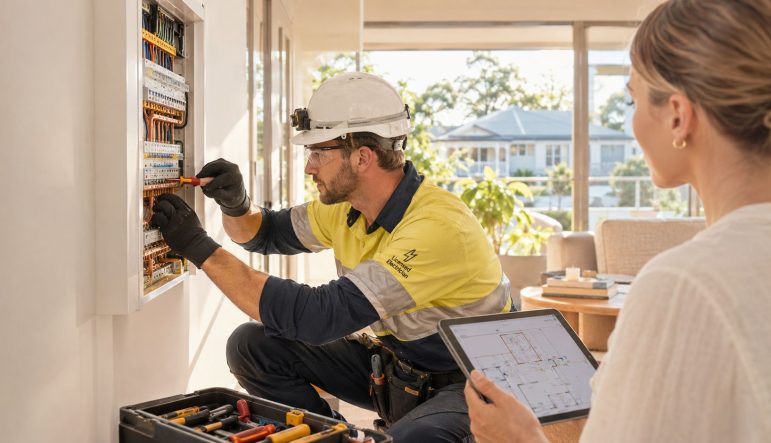
You're standing in the kitchen, the kettle and microwave are running, and the lights flicker. Or perhaps the old fuse box hums, a safety switch keeps tripping, or a renovation has exposed wiring that looks decades past its best. Those moments usually prompt the same question: does this home need rewiring, or will an electrician patch the immediate problem?
Rewiring a home is rarely just about replacing cables. In Brisbane, the job can overlap with switchboard modernisation, interconnected smoke alarms, roof-space access and plaster repairs. Get the order wrong and you may pay to open the same ceiling twice. Get it right and one organised project can deal with several safety and compliance issues together.
This guide gives you a practical decision path. You'll learn how to recognise a genuine rewire, what happens on site, how Queensland requirements affect the scope, what a quote should contain, and which questions separate an experienced residential electrician from someone selling a vague day rate.
Most homeowners don't wake up wanting to rewire the house. Something forces the issue. A power point feels warm, a light fitting cuts out, or the switchboard still has ceramic fuse carriers while every appliance in the home has become more demanding. Sometimes the trigger is less dramatic. You're planning a kitchen renovation, adding air-conditioning, or removing a wall, and suddenly the old wiring can't be ignored.
A Brisbane sparky will usually start by asking what changed. Did the fault appear after rain? Does one circuit trip, or does the whole home lose power? Have previous owners added extensions, sheds or extra outlets without properly reorganising the switchboard? Those details matter because a single faulty circuit and an installation that has reached the end of its useful life require different solutions.
Practical rule: A flickering light is a symptom, not a diagnosis. Don't approve a full rewire until the electrician has inspected the cabling, circuit protection, earthing and access conditions.
Queensland's broader electrical-safety picture gives the conversation proper weight. Across Australia and New Zealand, ERAC recorded 8 electrical deaths from 8 incidents in 2024–25, including 7 deaths in Australia, compared with 11 deaths from 10 incidents the year before. The reported rate was 0.32 deaths per million people in 2024–25, broadly consistent with the previous year. The regional electrical-safety figures and context are summarised here. Those figures don't prove that every old Brisbane home needs new cables, but they do show that electrical risk remains real and measurable.
The useful question isn't just “Is my house old?” Ask instead:
By the time an electrician arrives, you should be ready to discuss those four points. A good assessment will then tell you whether you need a complete rewire, targeted upgrades, or a staged plan.
A full rewire makes sense when the problem is spread through the installation, not confined to one replaceable component. Older rubber or cloth-sheathed cable can deteriorate, particularly where heat, moisture or movement has affected the insulation. Lighting circuits without a proper earth, ceramic fuse carriers, repeated safety-switch trips and discoloured outlets all deserve prompt investigation.
A switchboard that has been extended several times is another warning sign. Extra breakers may have been added without a coherent circuit schedule, spare capacity or modern residual-current protection. That doesn't automatically mean every cable must come out, but it does mean the electrician should inspect the whole system rather than quote for one isolated repair.
A 1960s low-set home with original wiring and a renovation ahead is usually a strong full-rewire candidate. Access is already being created, and leaving old cables behind walls that are about to be opened can make little sense. By contrast, a 1990s home with one defective circuit may need fault-finding, a circuit repair or a switchboard upgrade, not a wholesale replacement.
A targeted job may be the better call when:
Regional safety-switch coverage remains uneven. An industry briefing citing Master Electricians Australia states that around 40% of Australian homes have no RCD protection, while about 30% protect power circuits only and about 30% protect both power and lighting circuits. The briefing and its safety-switch figures are outlined in this Queensland smoke-alarm guidance. Treat those figures as a reason to check your board, not as proof that your particular home is unsafe.
| What You're Seeing | Likely Right Call | Why |
|---|---|---|
| Original rubber or cloth-sheathed cable throughout the home | Full rewire | Insulation condition and circuit suitability need a whole-installation assessment |
| Ceramic fuses, repeated trips and several informal board additions | Rewire assessment plus switchboard upgrade | Protection and cabling may both need attention |
| One faulty outlet or one damaged circuit in an otherwise sound installation | Partial repair | A local fault doesn't justify disturbing unaffected areas |
| Renovation exposing walls and ceilings in an older home | Full rewire often makes sense | Access is available, so new cabling can be installed without repeating demolition |
| New kitchen or air-conditioner on a modern installation | Dedicated circuit or targeted upgrade | The demand may be local rather than a whole-home wiring failure |
Before calling, check the switchboard type, note which circuits trip, look for warm or marked outlets, and ask whether previous work has left visible conduit or abandoned cables. Don't remove covers or probe wiring yourself. Give those observations to the electrician and let them test the installation properly.
A proper rewire starts at the switchboard, not with someone randomly pulling cables from walls. The electrician isolates the supply, confirms the installation is dead, checks existing RCD coverage and maps the final subcircuits. That early testing prevents the crew from designing a new system around assumptions.
Next comes access. In a timber-framed home, cables may run through wall cavities, under floors or through the roof space. Brick walls may require chasing, while an older or occupied home may suit surface-mounted conduit in selected areas. The electrician removes redundant cable where practical, then installs new cabling for power, lighting, data and smoke alarms according to the agreed scope.

The work usually moves room by room. Back boxes, outlets, switches and light points go in during the rough-in, then the electrician returns to terminate circuits and fit the visible accessories. The switchboard may receive a new enclosure, main switch and RCBO protection, depending on the design and existing equipment.
Expect drilling, chasing, dust and temporary loss of access. A lived-in rewire can keep the household functioning, but rooms may be unavailable while cables are routed and walls are opened. Power isolation is planned around the work, although the final switchboard changeover requires a controlled interruption.
Before the crew arrives: Move furniture away from walls, cover items that can't be moved, clear roof-space access, arrange pets away from open doors, and decide whether the family will remain in the home.
Tell the electrician early if you want extra outlets, pendant lights, data points, outdoor power or future appliance circuits. Adding those requests after walls are patched is expensive and disruptive. Also decide whether you'll accept visible conduit in exchange for less chasing and patching, or whether concealed cabling is essential for the finished appearance.
Testing is the final trade step, not a paperwork afterthought. The electrician should verify polarity, insulation resistance, loop impedance and RCD trip performance before energising the installation. Ask for the relevant electrical certificate and a circuit schedule that clearly identifies what the new board controls.
A Brisbane rewire can become three jobs if the sequence is wrong: fixed wiring, smoke alarms and roof-space safety. Set the order before work starts. AS/NZS 3000:2018, the Australian and New Zealand Wiring Rules, governs the installation's design, construction and verification. Queensland smoke-alarm rules affect alarm locations, interconnection and power arrangements, while roof-space access can change how cables are routed through insulation and confined areas.
Use this sequence:
Queensland homes will need interconnected photoelectric alarms compliant with AS 3786-2014 by the statewide deadline of 1 January 2027. Hardwired alarms and alarms with 10-year batteries are accepted. New or substantially renovated homes already require interconnected alarms in bedrooms, hallways connecting bedrooms and every storey. Leased, re-leased or sold homes had earlier compliance obligations from 1 January 2022. WorkSafe Queensland explains the smoke-alarm installation requirements and replacement expectations.

Do not book smoke-alarm work as a separate visit if the ceilings are already open. Put the board design, alarm circuit protection and interconnection method in the written scope. Before accepting the quote, review Queensland switchboard upgrade regulations and ask how the proposed board will support the completed installation.
From 1 January 2025, Queensland applies extra safety measures before work in, or entry to, the roof space of a domestic building. Queensland Electrical Safety provides the current regulatory starting point. Ask the electrician to explain the access controls, cable protection and labelling required at your property. Bundle those tasks with the rewire. It costs less disruption than closing the roof space, then reopening it for compliance work later.
A rewire quote should be based on the building, access and scope, not a generic price per room. The figures in the table below are the planning ranges supplied for Brisbane work, and the final price still depends on what the electrician finds behind the walls.
| Home Type | Typical Cost Range | Duration | Cost Pushers |
|---|---|---|---|
| Typical three-bedroom brick home | $8,000 to $15,000 | 3 to 5 working days | Access, plaster repairs, circuit additions and switchboard condition |
| Larger Queenslander or two-storey home | $15,000 to $25,000 | 7 to 10 days | Multiple levels, roof-space access, concealed routes and heritage detailing |
These planning ranges and the factors behind them are set out in this guide to the cost of rewiring a house in Australia. Double-brick construction, solid walls and ornate plaster ceilings push labour up because routing cable becomes slower and repairs become more specialised. A heritage overlay can also require coordination with an architect or other professionals.
Switchboard relocation away from the original meter position is another common variation. So is asking for extra circuits, data cabling, outdoor outlets or a higher specification of fittings after the quote has been accepted. If ceilings need to be opened and patched, make-safe work and plaster rectification should appear as separate line items rather than being hidden inside a broad allowance.
The supplied Brisbane planning figures allow roughly $800 to $1,800 for a bundled switchboard upgrade and $300 to $600 for full Queensland smoke-alarm compliance. Those amounts should be treated as scope allowances, not guaranteed prices. Your electrician should confirm what equipment, labour and certification each allowance includes.
A fair quote should identify:
Avoid a lump sum with no scope. It may look simple, but you won't know whether the quote includes alarm interconnection, board replacement, patching or testing until a variation appears.
Fixed-wiring work in a Queensland home belongs to a licensed electrical contractor. The work most homeowners mean by rewiring includes new cable runs, circuit alterations, switchboard connections and hardwired smoke alarms. Changing a like-for-like accessory doesn't turn a homeowner into an electrician, and online videos can't replace testing, judgement or legal responsibility.
Unlicensed work can expose the homeowner to fines, insurance problems and serious injury risk. The supplied guidance identifies on-the-spot fines over $600 for a homeowner, along with the possibility of insurance being voided if a fire is traced to unlicensed work. Queensland's electrical-safety regulator is the appropriate place to check current obligations.

A professional won't automatically recommend the biggest job. They'll explain when a switchboard upgrade, RCBO installation or partial rewire is enough, and they'll tell you what would make a full rewire worthwhile.
For a second perspective on the questions to ask a contractor, these Safe Electric registered Dublin electrician tips are useful even though the local licensing system differs. For Brisbane-specific service considerations, you can also review this guide to choosing an electrician in Brisbane.
Consider a typical Northside job, a 1950s three-bedroom home in Nundah. The homeowner had original rubber-insulated cabling, a ceramic-fuse switchboard and three hardwired smoke alarms beyond their 10-year replacement date. The family also wanted to stay in the house during the work, which meant the electrician needed a staged plan rather than a rushed all-at-once shutdown.
The sensible decision was to combine the rewire with the smoke-alarm upgrade and roof-space inspection. Opening ceilings for one job, then returning for alarms or roof-space protection, would have created avoidable disruption. The electrician assessed the old circuits, planned the new board, mapped alarm positions and identified the areas where access would need to be protected.
Days 1 and 2 involved measuring and scoping. The electrician walked through every room, counted existing points, marked desired additions and checked the switchboard. The quote separated the rewire, board work, alarm installation, access requirements and patching rather than hiding everything under one heading.
Day 3 covered asbestos and condition checks. Older Brisbane homes can contain materials that shouldn't be drilled, cut or disturbed casually. The crew confirmed the work areas and adjusted the access plan before starting cable routes.
Days 4 to 8 were the progressive rewire. The electricians isolated working areas, routed new cables through accessible cavities and opened only the sections needed for each stage. The family stayed in the house, although rooms were taken out of service temporarily and furniture had to be moved ahead of the crew.

Day 9 was the switchboard changeover. The old ceramic-fuse arrangement was replaced, with temporary power planning so the household wasn't left without an agreed way to operate during the work. The electrician checked final subcircuits and confirmed the board could accommodate the new installation.
Day 10 dealt with the smoke alarms. Photoelectric interconnected alarms were fitted in the required bedrooms and hallways, with the interconnection and supply arrangements checked as part of the broader electrical scope.
Day 11 was testing and handover. The supplied project outline includes thermal imaging of the new circuits and a Certificate of Testing. The electrician also checked polarity, insulation resistance, loop impedance and RCD performance before energising the installation.
The total landed cost was around $11,500 for the three-bedroom, single-bath home, and the homeowner took only two half-days off work. Those figures belong to this described project, not a promise for every Brisbane home. Construction, access, fittings, roof-space conditions and variations can change the result.
If your Brisbane home has old wiring, don't wait until the renovation is underway to raise the issue. Book a free on-site assessment with DLG Electrical, which services Brisbane's Northside and inner suburbs, and ask for a written quote within 48 hours so the rewire, smoke-alarm upgrade and switchboard work can be sequenced into one compliant job.
DLG Electrical can assess whether your home needs a full rewire, partial upgrade or coordinated switchboard and smoke-alarm work. Visit DLG Electrical to arrange a free on-site assessment and get the project planned properly before ceilings are opened.

Master Electrician with over 30 years of experience. Founded DLG Electrical in 2005 after international project work including electrical installations at Stamford Bridge Stadium, London(Home of Chelsea FC).

Local Electricians that can fix all Electric Hot water Systems.
Motion sensor lights are a versatile addition to any home, offering nu
