83 Jean St, Grange QLD 4051
Mon-Fri 07:30 AM - 04:00 PM - Sat - 8:00 - 12 - Sunday Closed
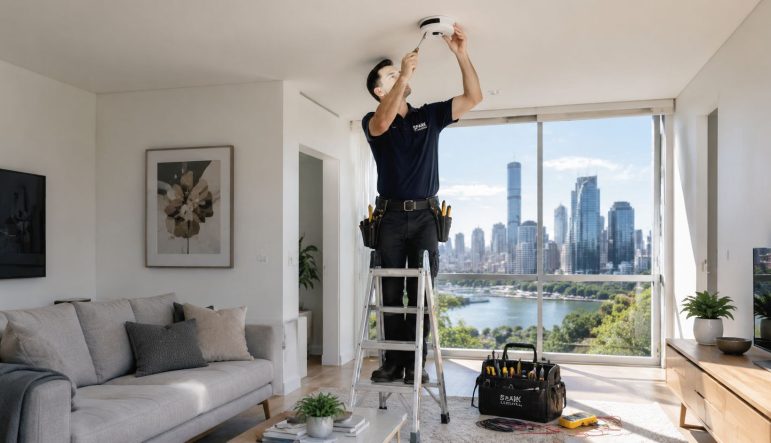
If you're looking around your Brisbane home wondering whether the alarms on the ceiling are compliant, you're not alone. A lot of owners have something installed, but they still don't know if it meets the current Queensland standard, whether the bedrooms are covered properly, or whether an older alarm that still chirps on a button press is already past its safe life.
That uncertainty gets more serious as the 1 January 2027 deadline gets closer for existing private homes, townhouses and units in Queensland to meet the current smoke alarm rules, as set out by the Queensland Fire Department smoke alarm requirements. For Brisbane homeowners, landlords and renovators, the key question isn't just what the law says. It's whether your actual layout, wiring and alarm mix would pass a practical compliance check.
Brisbane homes are rarely all the same. Some are post-war cottages with piecemeal renovations. Some are split-level brick homes. Some are townhouses with bedrooms upstairs and living areas below. That matters because smoke alarm compliance isn't just about having a detector somewhere in the house. It depends on type, placement, interconnection, power source and age.
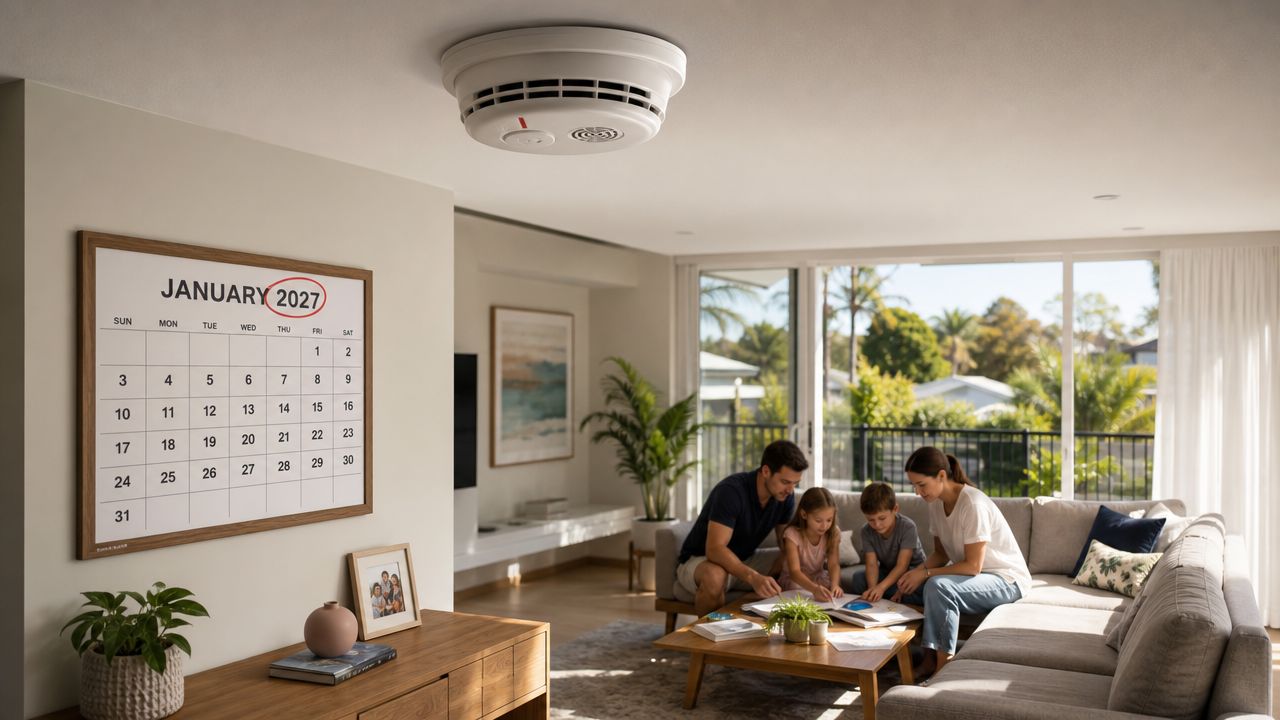
For a lot of people searching for smoke detectors Brisbane, the pressure comes from one of three situations. You're selling. You're managing a rental. Or you're finally checking a setup that's been untouched for years.
A compliant system gives earlier warning across the whole dwelling. That's the practical point of the Queensland rules. If smoke is detected in one part of the home, occupants in another room or on another level need to hear that alarm immediately.
Practical rule: If your home relies on one old hallway alarm to protect sleeping areas, that setup is unlikely to match what Queensland now expects.
Queensland's broader safety trend has been moving in this direction for a long time. The Australian Bureau of Statistics reported that the proportion of Queensland homes with smoke detectors rose from 39% in October 1996 to 69% in October 2001, a 30 percentage-point increase in five years, according to the ABS release on Safety in the Home in Queensland.
The common assumption is simple. If an alarm is on the ceiling and makes noise when tested, the job must be done. In practice, that's where problems start.
A Brisbane compliance check often uncovers issues like:
That's why compliance matters now. It protects the people in the house, and it avoids a rushed scramble later when a sale, lease renewal or renovation forces the issue.
Queensland's rule for existing private homes is specific. By 1 January 2027, the home must have interconnected photoelectric smoke alarms that meet AS 3786:2014, installed in every bedroom, in hallways that connect bedrooms, or on the likely exit path if there is no hallway, and on each storey. The same Queensland guidance also states that if you already have hard-wired alarms, they must be replaced with hard-wired photoelectric models by a licensed electrician, as outlined by the Queensland Fire Department smoke alarm law.
A lot of the confusion comes from the wording, not the rule itself.
If you want a plain-English breakdown of the legal framework, this guide to current smoke alarm legislation in QLD is a useful companion read.
The wording sounds straightforward until you apply it to an actual floor plan. Bedrooms upstairs, a study downstairs, a converted garage, a rear extension, a sleepout, or a split-level landing can all change how the layout should be assessed.
The safest way to read the law is to follow sleeping areas and exit paths, not just room labels on an old plan.
That matters because a home can have alarms installed and still miss a required location. It can also have the right number of alarms but fail because they're not interconnected or not the correct type.
When checking your own home, use this short compliance benchmark:
Bedroom coverage
Every bedroom needs its own compliant alarm.
Connection path coverage
Hallways connecting bedrooms need coverage, or the likely exit path if there isn't a hallway.
Storey coverage
Each level of the dwelling needs an alarm.
System behaviour
When one goes off, they should all go off.
Correct device type
The alarms need to be photoelectric and compliant with AS 3786:2014.
Power source
The system needs to be either compliant hard-wired units or compliant sealed 10-year battery units, depending on the installation.
If your current setup misses any one of those points, it needs attention.
Once you know the legal target, the next job is choosing the hardware that fits your home. Most Brisbane owners are really deciding between hard-wired photoelectric alarms and 10-year battery photoelectric alarms. The law allows both in the right circumstances, but they don't suit every property equally well.
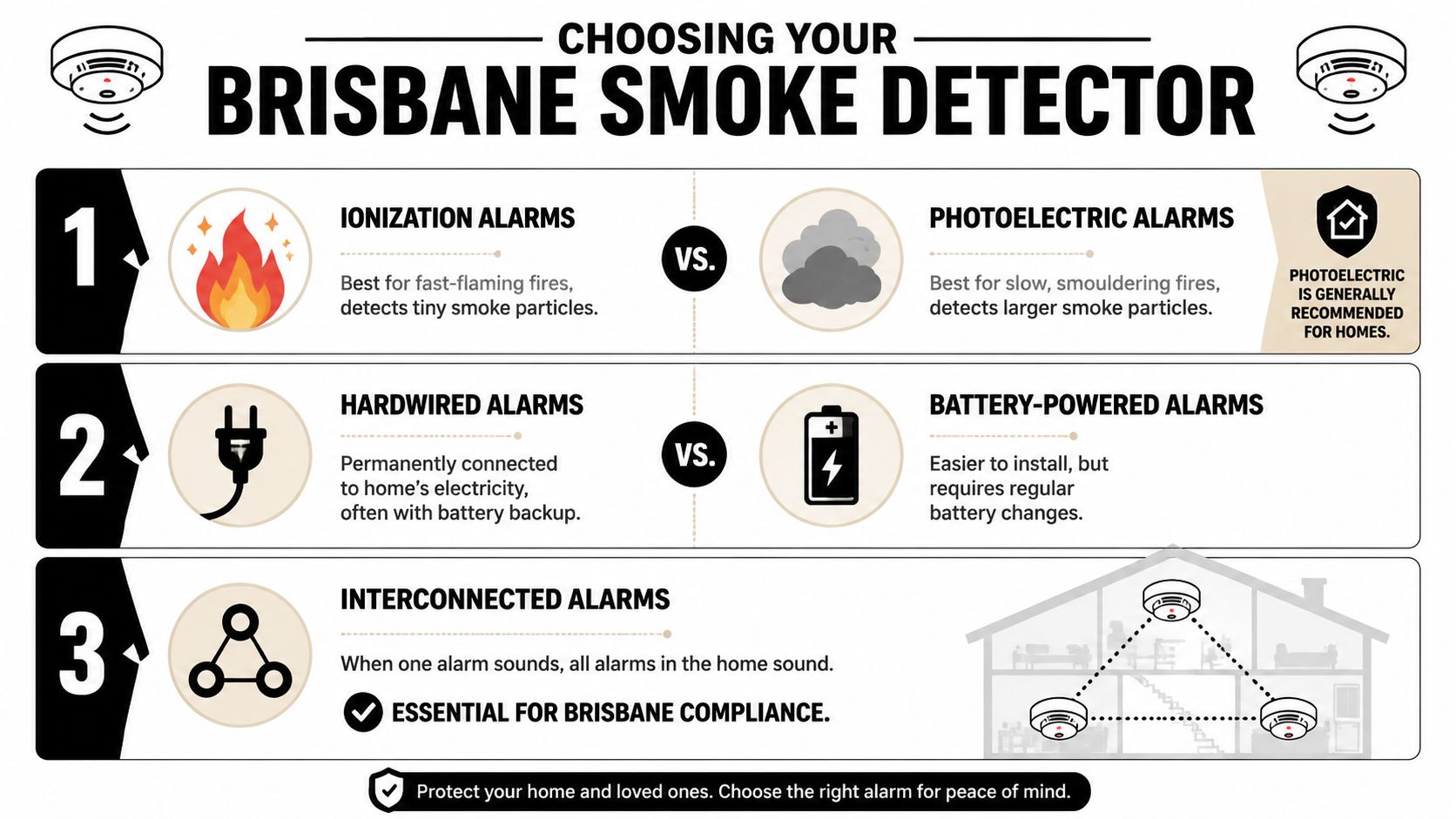
For Brisbane homes, the practical choice is a photoelectric alarm that meets the required standard and can be fully interconnected with the rest of the system. That's the baseline.
What doesn't work well is trying to keep a patchwork system alive. An old hard-wired unit in one hallway, a battery alarm from the hardware store in a bedroom, and another unrelated device near the stairs usually creates more problems than it solves. Even if each unit seems functional on its own, the overall system may not behave as one network.
A product guide on good smoke alarms for Queensland homes can help if you're comparing compliant options.
The best choice depends on the building, access, existing wiring and the scope of the job.
| Feature | Hardwired Photoelectric Alarm | 10-Year Battery Photoelectric Alarm |
|---|---|---|
| Compliance fit | Suitable where hard-wired installation is practical | Suitable where a sealed long-life battery model is appropriate |
| Installation | Must be installed or replaced by a licensed electrician | Can suit homes where wiring access is difficult |
| Best use case | Renovations, rewires, homes with existing mains alarm circuits | Existing homes where ceiling access or wiring upgrades are limited |
| Power source | 240V with secondary power source | Non-removable 10-year battery |
| Upgrade pathway | Good for integrated electrical work | Useful where minimal building disturbance matters |
A renovated Queenslander often suits a planned hard-wired upgrade if ceilings are already open or other electrical work is happening. A finished brick home with difficult access may be better served by sealed 10-year battery interconnected alarms, provided the selected products meet the Queensland requirements.
Don't choose by unit price alone. Choose by whether the final system will be compliant, interconnected and maintainable.
Three practical trade-offs matter most:
Existing wiring condition
If you already have older hard-wired alarms, replacement has to be handled properly. You can't swap a hard-wired system for an easier non-matching fix and assume it's compliant.
Ceiling access and finish quality
Hard-wired upgrades may involve more labour where access is poor or finishes need to be preserved.
Long-term servicing
A neat, uniform system is easier to test, document and replace later than a mixed collection of brands and ages.
For those searching smoke detectors Brisbane, the winning option isn't the cheapest unit. It's the setup that fits the building and doesn't leave a compliance question hanging over the home.
Placement is where many Brisbane homes fall short. Owners often know they need alarms in bedrooms and hallways, but the sticking point is how that applies to unusual layouts. That's especially true in split-level homes, renovated properties and houses with added rooms or altered exit paths. The Queensland Fire Department notes that applying the placement rules in those real-world settings takes careful planning so all exit paths are covered and the system is fully interconnected, as explained in the Queensland smoke alarm FAQ.
Take a copy of your floor plan, or sketch the house if you don't have one. Then work through it as a sleeping and escape map, not a real estate brochure.
Check these points:
Mark every bedroom
Each bedroom needs its own compliant alarm.
Trace the path from bedrooms to the exit
If bedrooms open onto a hallway, that hallway needs protection. If they don't, identify the likely exit path.
Check every level
Each storey needs an alarm, even if one level isn't used for sleeping.
Look at stairs and landings
Multi-level homes need careful placement so alarms cover movement between levels properly.
Older Brisbane homes often have sleepouts, enclosed verandahs, rumpus conversions and rear additions. The room names on council paperwork or old plans don't always reflect how the space is used now.
That creates practical issues such as:
If someone sleeps there, walk the path they would take when waking to smoke at night. That usually reveals where the alarm coverage is missing.
Good placement also depends on how the unit is mounted, not just which room it's in.
Keep these practical points in mind:
Ceiling position matters
Alarms should be positioned so smoke can reach them properly. Crowding them near corners, beams or fittings can reduce effectiveness.
Avoid nuisance locations
Too close to kitchens, bathrooms or strong air movement can lead to repeated false alarms and eventual neglect.
Interconnection has to be complete
A partly linked system isn't enough. Every required alarm has to function as one system.
If you're auditing smoke detectors Brisbane properties yourself, the fastest way to get clarity is to stop counting devices and start assessing coverage, path of travel and interconnection as one complete design.
You press the test button, one alarm beeps, and it feels like the job is done. In a lot of Brisbane homes, that is where maintenance stops. The problem is that a smoke alarm can still make noise and still be a poor safety device if the sensor is old, the unit is full of dust, or the interconnection is not responding the way it should.
Queensland Fire and Emergency Services reported in its QFES Community Insights Survey 2020 that many homes had alarms installed, but fewer had alarms that were operational. That gap matters because people usually find out there is a fault at the worst time, during a chirping fault overnight, a failed sale inspection, or an emergency.
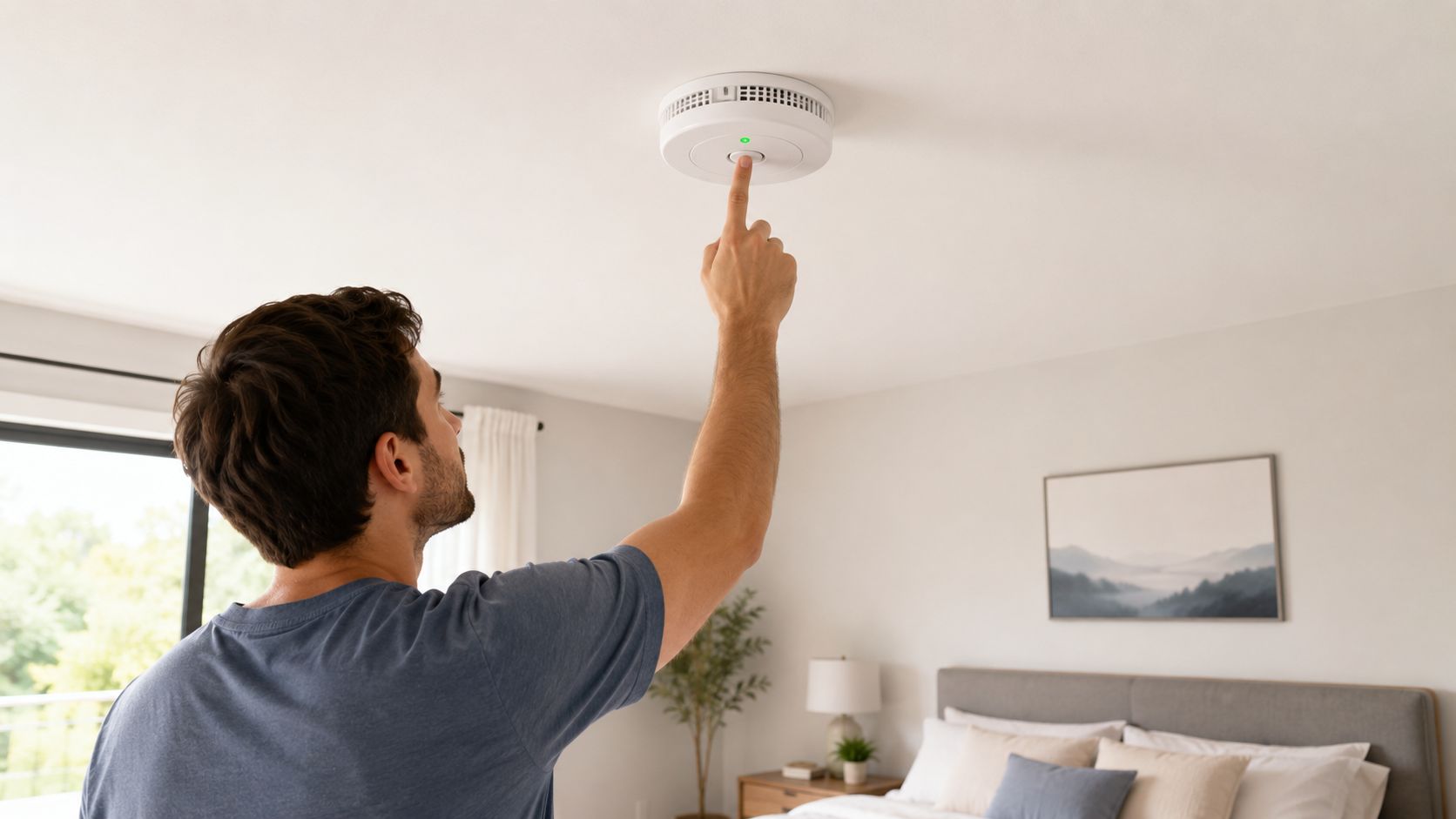
A button test is only one part of the check. It confirms the alarm has power and the sounder works. It does not confirm the sensing chamber is still dependable, and it does not always tell you whether every interconnected alarm is responding properly.
For Brisbane homeowners doing a practical audit, check these points room by room:
Press each test button and listen across the house
Every required interconnected alarm should trigger, not just the one you touched.
Check the manufacture or replacement date
If the unit is at or near 10 years old, treat it as due for replacement even if it still sounds.
Look for yellowing, paint, insect debris, or repeated fault chirps
These are common signs the alarm is aging or has been neglected.
Notice household habits
If an alarm near a kitchen or bathroom is constantly going off and gets silenced or ignored, that is a risk and often a placement or product issue that needs fixing.
Confirm nothing has changed in the home
A room that has become a sleeping area changes what "working" needs to mean in practice.
That last point gets missed all the time. An alarm setup that suited the home five years ago may not suit it now.
Monthly testing is sensible. So is cleaning the units a couple of times a year with the method recommended by the manufacturer, usually a careful vacuum around the vents rather than sprays or aggressive wiping. Replace alarms at the end of their service life, even if they still chirp or pass a quick button press.
If you want someone to check the system properly against both safety and legal expectations, book smoke alarm testing services rather than relying on memory and a ladder once a year.
Owners who manage several properties often keep their maintenance records with the same discipline they use to create customer estimates, because dates, model numbers, and replacement history matter when faults or compliance questions come up.
This is the trade-off homeowners need to understand. Keeping an old alarm because it still beeps feels cheaper today, but it increases the chance of sensor failure, nuisance alarms, and last-minute replacement under pressure.
In practice, the alarms I would be most suspicious of are the ones that appear fine from the floor but have no clear install date, mixed brands across the house, or inconsistent response during testing. Those systems often give owners false confidence. A neglected alarm does not just malfunction imperceptibly. It can leave part of the house without proper warning while everyone assumes they are covered.
Keep a basic record for each alarm:
That record is useful for landlords, sellers, and owner-occupiers alike. It also makes the next inspection much faster and helps you spot the difference between a minor maintenance job and a system that has reached replacement age.
A common Brisbane call goes like this. The alarms still chirp when tested, the house has had a few renovations, and the owner wants to know whether anything needs changing before a sale, new tenancy, or family move-in. That is the point where a quick battery swap stops being enough. You need to know what is installed, how old it is, whether the locations still match the current layout, and what has to be upgraded by a licensed electrician.
The practical way to handle it is to audit the home room by room. Start with the bedrooms and paths of travel. Then check whether every required alarm is photoelectric, interconnected, and within service life. After that, look for the problems that catch people out in older Brisbane homes: a spare room now used as a bedroom, an extension with no linked alarm, hard-wired units mixed with stand-alone battery alarms, or devices with no visible date mark.
A smoke alarm system that "works" during a button test can still be a liability. If the install date is unknown, if brands and models are mixed across the house, or if one alarm sounds and the others stay silent, treat that as a warning sign. In real jobs, those are the homes that often need more than a simple replacement of one unit.
Some jobs need proper electrical work and a compliance check on site.
Call a licensed electrician if:
Your home already has hard-wired alarms
Replacement needs to match the wiring setup and current legal requirements.
The alarms are not fully interconnected
This often shows up in houses with staged renovations or older additions.
You are unsure whether the current locations still suit the way the home is used
A study turned bedroom, a converted garage, or a split-level layout can change what is required.
You want clear records of what was installed
That matters for landlords, sellers, and owners who do not want to guess later.
DLG Electrical provides Brisbane smoke alarm assessment, compliant product supply, installation and certification support as part of its electrical services.
Homeowners can do a useful first pass without touching any wiring. Walk through the property and ask:
If the answers are patchy, the system needs closer attention. That does not always mean a full rewire. In some homes, sealed 10-year battery interlinked alarms suit the layout and budget. In others, especially where hard-wired alarms already exist, replacing like for like with compliant interconnected units is the cleaner long-term choice. The right option depends on the house, not just the price of the alarm on the shelf.
If you are comparing installers or managing upgrades across more than one property, it helps to standardise the quoting and approval process. A practical way to do that is to use a system that can create customer estimates and keep scope, approvals and invoicing aligned, especially when compliance work is tied to renovation schedules or tenancy turnover.
A good smoke alarm outcome leaves you with:
If your home has a mix of old hallway alarms, unknown install dates, or rooms that have changed use over time, get it checked properly.
If you want a clear answer on whether your home is compliant, contact DLG Electrical for a free, no-obligation quote. They can assess your current setup, identify any gaps in placement or alarm type, and advise what needs to be upgraded for a safer, compliance-ready Brisbane home.

Master Electrician with over 30 years of experience. Founded DLG Electrical in 2005 after international project work including electrical installations at Stamford Bridge Stadium, London(Home of Chelsea FC).

Local Electricians that can fix all Electric Hot water Systems.
Motion sensor lights are a versatile addition to any home, offering nu
