83 Jean St, Grange QLD 4051
Mon-Fri 07:30 AM - 04:00 PM - Sat - 8:00 - 12 - Sunday Closed
You've probably done what most Brisbane homeowners do first. Opened a few tabs, searched for solar companies in Brisbane, and found a mess of “top installer” lists, big discount claims, and quote forms that want your phone number before they tell you anything useful.
That's where people get burned.
A solar system can absolutely be a strong investment in Brisbane, but only if the installer sizes it properly, explains the export rules clearly, and checks whether your switchboard and existing electrical setup can safely support it. The sales pitch usually focuses on panels because panels are easy to market. The expensive mistakes usually sit somewhere else.
Brisbane also isn't a market where you should judge value by panel price alone. A typical 6.6 to 10 kW residential system is commonly quoted at about A$6,378 to A$9,663, with estimated annual savings of roughly A$1,296 to A$2,000 and a payback period of about 4.8 to 4.9 years, according to Brisbane solar pricing and payback data. That can work very well. It can also disappoint if the quote ignores export limits, poor daytime usage patterns, or hidden electrical upgrade work.
Good installers talk about those issues early. Weak ones leave them for later.
The first filter isn't price. It's whether the company is legitimate, properly licensed, and likely to still be around when you need warranty support.
That matters more now because the Australian solar installation industry is substantial but has also tightened. As of 2026, the industry has a market size of $2.3 billion and has contracted at a 7.3% annual rate since 2021, according to IBISWorld's solar panel installation industry data. In plain terms, some operators won't survive a tougher market. If a company disappears, the warranty brochure in your hand won't help much.

Start with the essentials:
If they hesitate on any of those, move on.
A practical shortlist usually has three types of companies:
| Type | What they often do well | What to watch |
|---|---|---|
| Local electrician-led installer | Better grasp of switchboards, fault finding, compliance | Sometimes slower quoting |
| Sales-led national solar brand | Fast quoting, polished sales systems | Service may be remote or subcontracted |
| Mid-sized local solar specialist | Balanced process, often stronger local referrals | Quality varies by crew and management |
You're not choosing the nicest brochure. You're choosing who'll be on your property, on your roof, and inside your switchboard.
Practical rule: If a company can't clearly tell you who designs the system, who installs it, and who services warranty issues in Brisbane, it hasn't earned a place on your shortlist.
Use the company name and licence details to verify what you can yourself. Search their business footprint, look for a local trading history, and check whether the same name appears consistently across invoices, licence details, reviews, and service records.
A company that also does broader electrical work often has a stronger grip on compliance issues than a pure sales outfit. That's one reason some homeowners start by speaking with a local electrician in Brisbane for established homes and upgrades before they commit to a solar quote.
Don't overcomplicate this first stage. You're not trying to pick the winner yet. You're cutting out the companies that shouldn't be quoting your job in the first place.
A Brisbane homeowner gets three solar quotes. All promise good savings. All show decent-looking panels. Then the install starts, and one price blows out because the switchboard is non-compliant, the export limit is lower than assumed, and the "battery-ready" inverter is only battery-ready with extra gear nobody mentioned.
That is how people get caught.
A quote's job is to show the scope, not just a system size and a price.
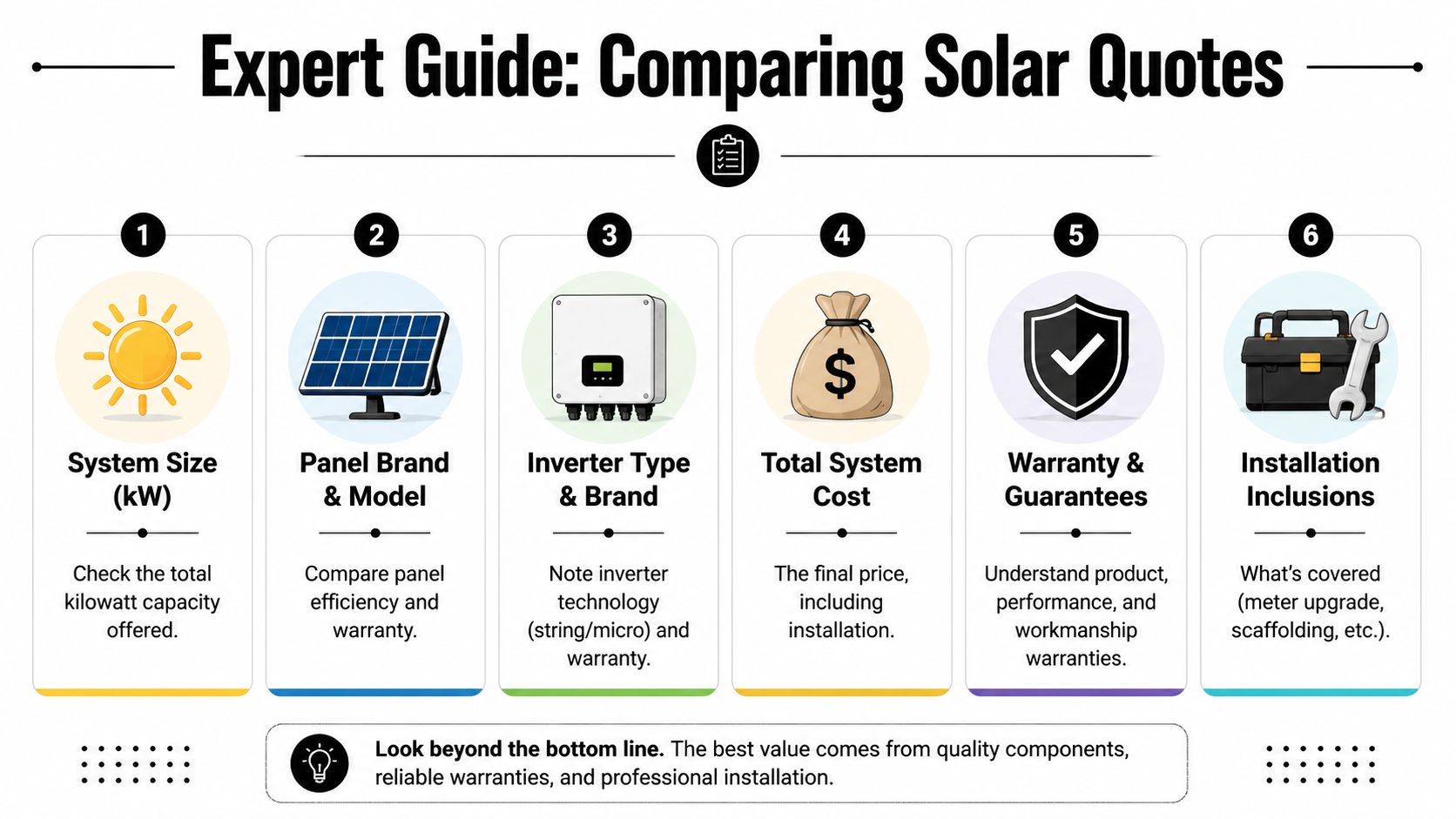
I'd start with the parts that are hardest and most expensive to fix after signing.
Electrical scope
Check whether the quote includes isolators, cable runs, protection devices, labelling, shutdown procedure, and any switchboard work already identified. On older Brisbane houses, this line matters more than the panel brand. If the quote says switchboard upgrades are "if required" but gives no allowance or process, expect trouble.
Inverter brand and exact model
The inverter decides monitoring, export control, and how practical a future battery will be. A cheap quote with the wrong inverter can cost more in the long run than a better quote with gear that suits your usage and network conditions. If you want battery flexibility later, it helps to understand what a Sungrow hybrid inverter setup actually allows.
Panel brand and exact model
"Tier 1" and "premium" are sales words unless there is a model number beside them. You need the exact product listed so you can compare like for like.
Mounting system and roof method
Tile, tin, pitch, access, corrosion exposure, and how penetrations are sealed all affect labour and long-term reliability. A vague line item usually means the quote has been built for speed, not for your roof.
Approvals and network paperwork
Energex applications, meter changes, and export approval assumptions should be spelled out. If a company has based its savings pitch on exports, ask what export limit they have allowed for.
Exclusions
Within exclusions, cheap quotes often hide their margin. Read every line.
Here's a useful visual walkthrough before you compare line items:
As noted earlier, Brisbane quote ranges can look tight on paper and still cover very different jobs.
One installer may have allowed for a clean, modern switchboard and easy meter access. Another may have assumed nothing and left the hard bits for variation charges later. On older properties in suburbs with plenty of 70s, 80s, and early 90s housing stock, that difference is common.
Look for these items before you compare totals:
If a quote is thin on detail, the low price is not automatically value. It often just means the missing costs have been pushed to later.
A strong quote explains why the system was sized that way for your house.
Ask what daytime usage pattern they assumed. Ask what export limit they allowed for. Ask whether the payback case still stacks up if exports are restricted and your feed-in tariff stays low. Brisbane homeowners who miss this step often buy too much panel capacity and not enough control over how the system behaves.
Maintenance matters too, especially if trees, grime, or roof access are part of the picture. Even though it is written for a different market, this guide for Arizona solar homeowners is a useful reminder that cleaning access and ongoing upkeep should be considered before install day, not after.
The solid quote
Clear hardware schedule, clear electrical scope, realistic exclusions, and a reasoned explanation of inverter choice, usage assumptions, and export conditions.
The cheap trap
Sparse technical detail, inflated savings claims, broad wording around site conditions, and no straight answer on switchboard compliance.
The polished overquote
Good presentation, plenty of branding, but no better design logic, no stronger warranty process, and no real service advantage after the install.
A quote should tell you how the installer plans to make the system work on your property, with your roof, your switchboard, and your network limit.
Ask these and then stay quiet long enough to hear whether the answer is specific or rehearsed:
A good installer answers those without squirming. A weak one goes back to panel wattage and headline savings because that is easier than talking about the parts of the job that can go wrong.
A lot of homeowners still shop by panel count. That used to be more forgivable. It isn't now.
In Queensland, the actual financial result from solar depends heavily on self-consumption, battery storage suitability, and local export limits, not just how many panels fit on the roof. Low feed-in tariffs and network rules can affect your payback more than the advertised panel deal, as noted in this Brisbane-focused discussion of export limits and tariff design.

The inverter is the working brain of the system. It handles the conversion from DC to AC, system monitoring, and often determines how easily you can add a battery later.
That's why the right question isn't “How many panels do I get?” It's “How will this system behave on my property, with my roof layout, my daytime usage, and my network conditions?”
Some homes suit a straightforward string inverter setup. Others benefit from more module-level control because of shading, split roof faces, or awkward orientation. The right answer changes house by house.
For homeowners looking into battery-ready gear, product-specific reading helps. One example is this Sungrow hybrid inverter guide for Brisbane properties, which gives useful context on what hybrid hardware is meant to do.
Here's the trade-off many quotes skip.
If your household exports a lot of power during the middle of the day and gets paid very little for it, then a bigger system doesn't automatically mean better value. Sometimes it just means more cheap exports.
Better value often comes from matching the system to how the home uses electricity:
Don't buy a system based on what it produces on paper. Buy it based on what your household will actually use.
The strongest Brisbane installs tend to start with household behaviour. Are people home during the day? Is there a pool pump, ducted air, electric hot water, or future EV charging? Is battery storage likely later?
That's the practical path. Not “biggest system wins”.
For a general maintenance perspective, I've seen homeowners benefit from practical checklists that focus on keeping systems performing properly after installation. Even though it's written for a different market, this guide for Arizona solar homeowners is a decent reminder that monitoring, cleaning, and regular inspection matter once the install is done.
The roof work gets the attention. The compliance work decides whether the job is safe, legal, and insurable.
That's especially important in older Brisbane homes. A key issue for local homeowners, particularly landlords and renovators, is post-installation compliance. Many older properties need switchboard upgrades before they can safely support a solar PV system, according to this Brisbane-focused note on older homes and compliance.
Established suburbs often have older switchboards, mixed-era cabling, limited space, outdated protection, or previous electrical work that was acceptable decades ago but creates problems now.
A solar salesperson might glance at the board and keep talking. A licensed electrician doing a proper pre-install assessment usually notices the issues:
That's where hidden costs come from. Not from the panels. From the house.
A reputable installer should manage the application and coordination side rather than leaving you to chase forms and approvals yourself. They must also identify whether separate electrical rectification is needed before the solar date is booked.
If a company says, “We'll sort it on the day,” be careful. That often means one of two things. Either they haven't looked properly, or they're comfortable springing variations once your deposit is paid.
A clean process usually looks like this:
If you're managing renovations or an investment property, broader compliance thinking helps. This isn't a solar-specific resource, but the guide to Australian business governance is a useful reminder that documentation, accountability, and traceable compliance processes matter in every regulated service environment.
The cheapest solar quote can become the most expensive one if it lands on a house that needed electrical work first.
Once the installation is complete, ask for every compliance document you're entitled to receive. For electrical work in Queensland, that paperwork isn't admin fluff. It's part of proving the work was done properly.
If you want to know what that document trail should include, this Electrical Certificate of Compliance guide is worth reading before the install date, not after.
A solar system is supposed to stay on your roof for years. That means the installer matters almost as much as the hardware.
Australia has completed over 4.1 million solar installations since 2001, but installation activity in 2024 was 16% below the 2021 peak, according to national solar installation figures compiled here. That points to a more mature market and ongoing consolidation. Some companies will merge, change hands, or vanish. You want one that can still answer the phone when an inverter fault shows up later.
Many homeowners hear “25-year warranty” and assume they're covered from every angle. They're not.
Check these separately:
If the salesperson keeps jumping back to the longest warranty in the pack, ask them to slow down and separate each one.
Some warning signs are obvious. Others are subtle.
Pressure to sign on the first visit
Good installers don't need fake urgency.
Vague wording on components
If the quote doesn't identify exact brands and models, the company wants flexibility that benefits them, not you.
No clear Brisbane service pathway
If a fault occurs, you should know who comes out, who authorises repairs, and where they're based.
Overpromised savings
Serious operators talk about usage patterns, exports, and limitations. They don't act like every house gets the same result.
If the sales process feels rushed, the after-sales support usually is too.
One more thing. Don't confuse a long manufacturer warranty with a strong installer. Products don't lodge claims. People do.
You're at the kitchen table, two quotes in front of you, and both sales reps say their system is the right one. One promises bigger savings. The other promises better gear. Neither answer means much until you start asking the questions that expose how the job will be designed, installed, and supported on your house.
Use the same checklist with every installer. That is how you separate a polished sales pitch from a company that has properly looked at your roof, your switchboard, and the export limits that affect real payback in Brisbane.
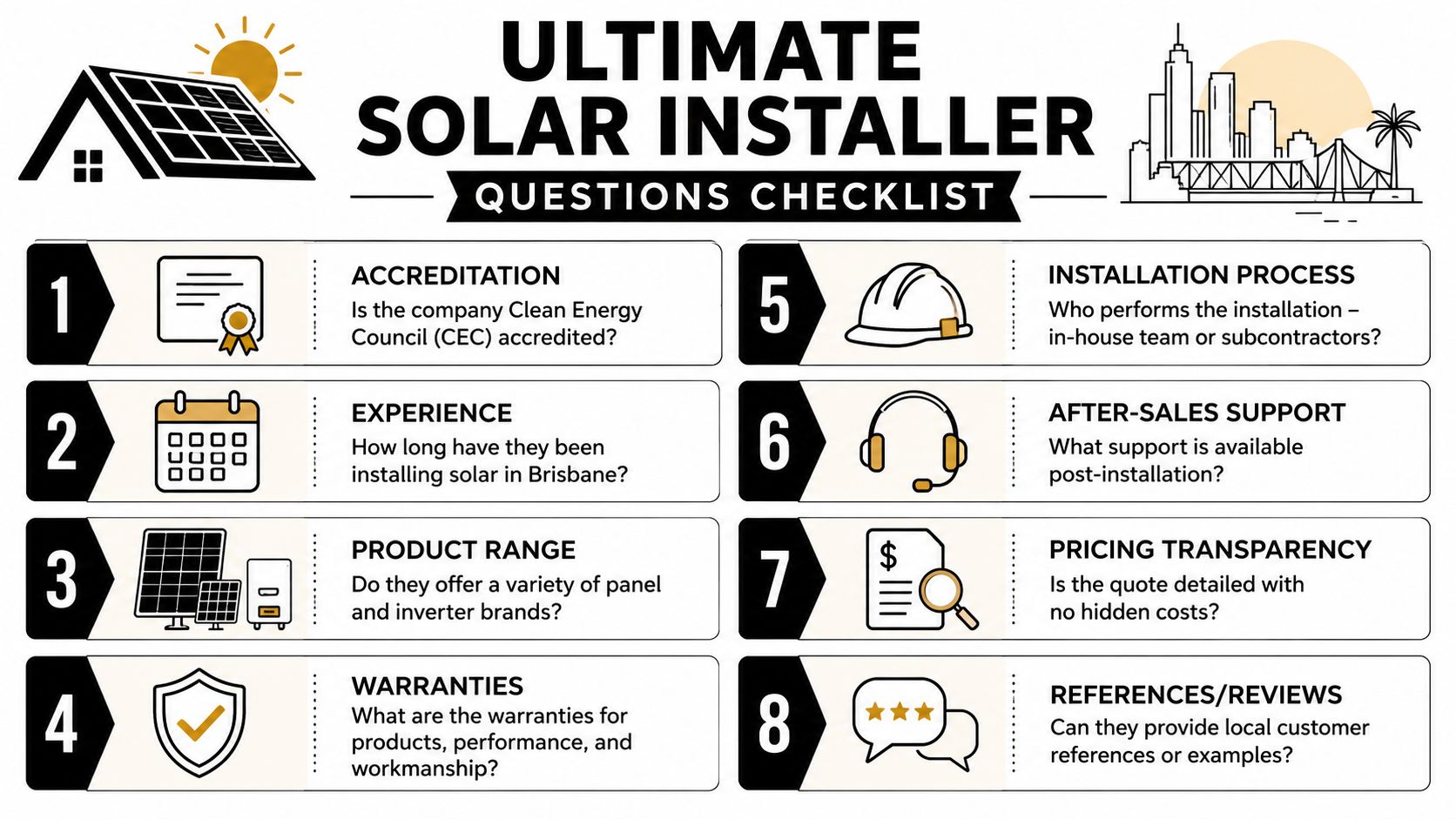
Who designed this system, and who will install it?
Ask for names and roles. Find out whether the install crew is in-house or subcontracted, and who carries responsibility if there is a problem later.
What exact panel, inverter, and battery models are included?
Get model numbers in writing. Brisbane homes with low feed-in tariffs and export limits need a system matched to how power is used on site, not vague labels like “premium” or “battery-ready”.
Why is this system size right for my house?
A proper answer should cover daytime usage, roof orientation, likely export constraints, and whether a smaller or differently configured system may give better value.
Has anyone checked the existing electrical setup properly?
On older Brisbane homes, this matters. Ask whether the switchboard, meter panel, earthing, and cable routes have been inspected or whether the quote is based on assumptions.
What extra electrical work could be required?
Get them to spell out likely upgrade items before contract stage. If the house needs switchboard work, compliance rectification, or meter panel changes, you want that discussed early.
What approvals and paperwork do you handle?
They should explain the process clearly, including distributor approvals, meter coordination, and any steps that depend on your retailer or network rules.
What monitoring platform will I use, and what will it show me?
Good monitoring helps you catch faults, track self-consumption, and decide whether a battery is worth adding later.
How do faults and warranty claims work in practice?
Ask who you call, who comes to site, and whether they service Brisbane directly or pass you to a manufacturer call centre.
Can you show me recent Brisbane jobs similar to mine?
Similar roof pitch, similar house age, similar household usage. A new build at North Lakes is not the same job as an older place in Camp Hill or Ashgrove.
The better installers are usually the plainest talkers. They will tell you where the limits are, what extra work may be needed, and whether a battery, a better inverter, or a switchboard upgrade makes sense for your place. They will also tell you when something is not worth doing yet.
Weak answers usually sound broad and polished. They keep drifting back to headline savings, oversized systems, or long product warranties without explaining how the house will handle the install.
If you want one practical benchmark, assess a well-regarded local electrical contractor the same way you assess everyone else. Ask about accreditation, experience with older switchboards, battery and inverter options under Brisbane export conditions, and who handles after-sales support. That is a fair standard for any solar company.
Before you accept a quote, ask yourself three things:
If any answer is no, keep looking.
If you want a straight answer on whether your home is ready for solar, DLG Electrical can inspect the switchboard, existing electrical setup, and practical upgrade requirements before you commit to an installation. That early check often prevents the expensive surprise that turns up halfway through the job.

Master Electrician with over 30 years of experience. Founded DLG Electrical in 2005 after international project work including electrical installations at Stamford Bridge Stadium, London(Home of Chelsea FC).

Local Electricians that can fix all Electric Hot water Systems.
Motion sensor lights are a versatile addition to any home, offering nu
