83 Jean St, Grange QLD 4051
Mon-Fri 07:30 AM - 04:00 PM - Sat - 8:00 - 12 - Sunday Closed
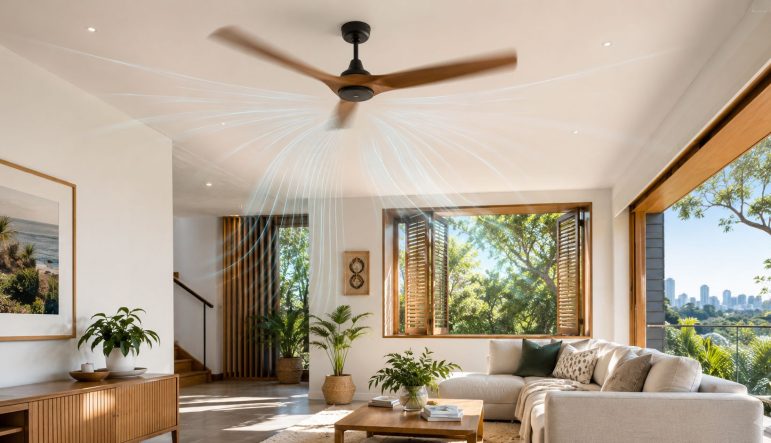
You know the feeling. It's late afternoon in Brisbane, the air is sticky, the fan is spinning flat out, and the room still feels heavy. The blades are moving, but the comfort isn't there. That's the part most homeowners run into. A ceiling fan can look busy without doing the job you need.
The difference is airflow. Not just whether the fan turns on, and not just whether it has big blades or a fancy light. In a Queensland home, especially with humid weather, open-plan living, and standard ceiling heights, the fan has to move air where people sit, sleep, cook, and relax. If it doesn't, the room feels stale no matter how fast the motor sounds.
A lot of fan advice online stops at a generic sizing chart. That helps a bit, but it doesn't answer why one fan feels brilliant in a bedroom and disappointing in a living area, or why a fan over the dining table can feel weaker after a pendant light or beam interrupts the air pattern. That's where practical installation and airflow understanding matter.
On a hot Brisbane afternoon, homeowners often blame the wrong thing. They'll say the fan is too small, too slow, or too old. Sometimes that's true. Just as often, the actual issue is that the fan isn't delivering useful ceiling fan airflow across the occupied part of the room.
That matters more here than many people realise. Brisbane heat isn't always about extreme indoor temperature alone. Humidity is what makes a room feel close and uncomfortable. A fan doesn't lower the room temperature by itself, but good air movement can make the space feel far more liveable because it helps sweat evaporate off your skin.
A fan that spins hard but misses the occupied zone won't feel effective, even if the motor sounds powerful.
I see this most in two situations. First, in open-plan homes where one fan is expected to serve a lounge, kitchen, and dining area all at once. Second, in bedrooms where the bed sits off-centre from the fan, so the airflow is technically there but not where the body feels it.
The signs are familiar:
A fan's job in summer comfort is simple. Move enough air, at the right location, at a speed that feels comfortable for long periods. When that part is right, the room feels lighter almost immediately. When it's wrong, people keep reaching for the remote and wondering why “high” still isn't enough.
A common Brisbane scenario goes like this. The fan looks big enough, the showroom tag says it has a strong motor, and once it is installed the room still feels flat and sticky by mid-afternoon. In that situation, the missing piece is usually airflow, not looks.
The figure that describes airflow is CFM, short for cubic feet per minute. It is a measure of how much air the fan moves in one minute.
CFM means the volume of air a fan moves in one minute.
Water flow is measured by how much comes out of a tap over time. CFM does the same job for air. It gives homeowners a practical way to compare one fan with another beyond finishes, blade count, or sales language.
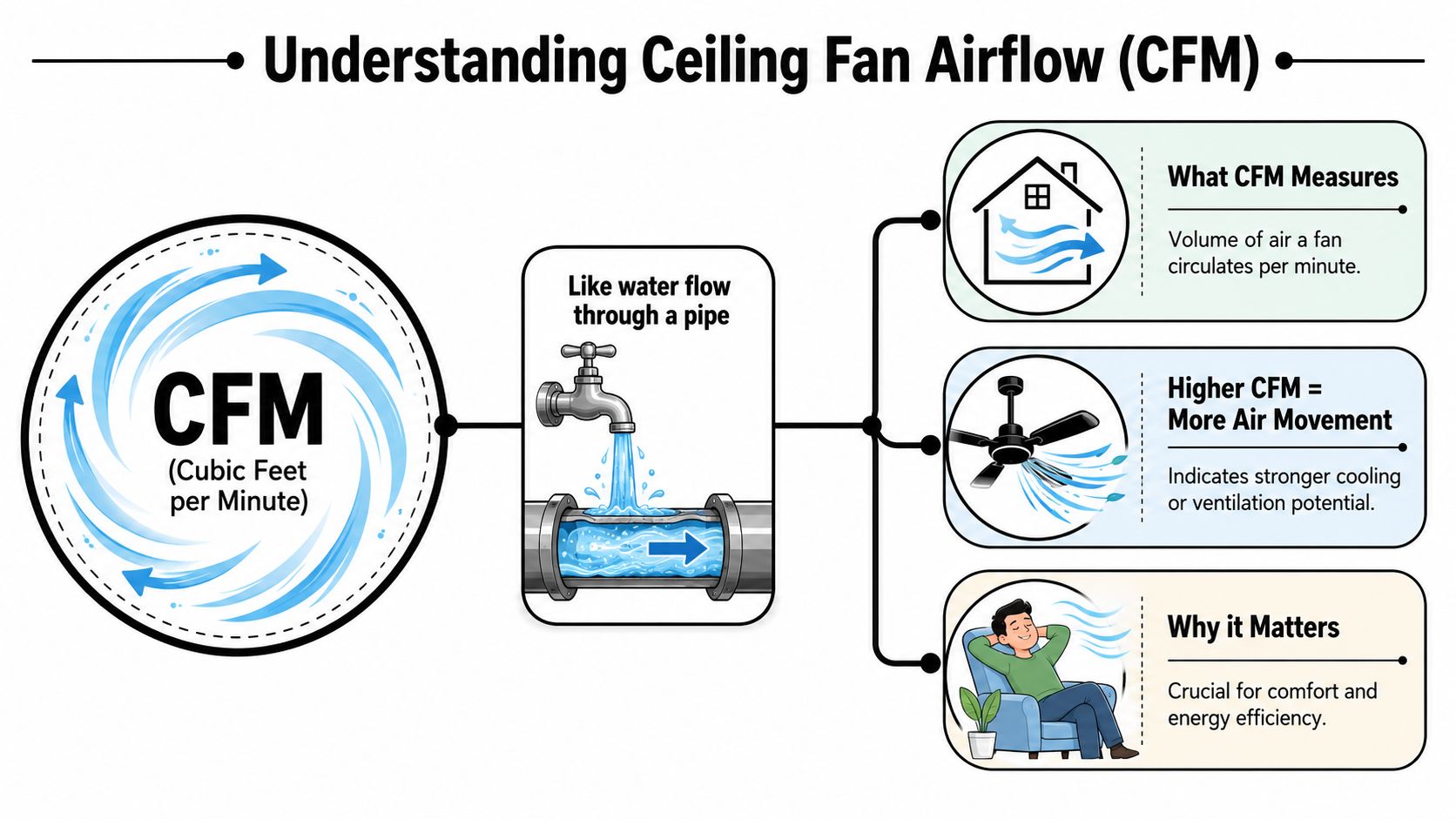
CFM is useful because it points to what people feel in the room. Air movement is the product you are buying.
A few practical checks help put that into context:
Manufacturers and testing bodies also use other airflow and efficiency units, including metric measures. If you are comparing ceiling heights while planning fan size or drop, Room Sketch 3D's ceiling dimension standards are a handy reference, especially for extensions and renovated Queensland homes where ceiling levels can vary between rooms.
CFM is a starting point. It does not tell you how the fan will behave once it is fitted into a real Brisbane home.
A published airflow number cannot account for a fan mounted tight to the ceiling, a pendant light sitting in the air path, or an open-plan layout where the seating area is well away from the centreline of the fan. Those details change how the room feels.
Real houses rarely behave like brochure diagrams. A fan in a simple square bedroom with standard proportions is usually predictable. A fan over a living and dining space with a kitchen bulkhead, raked section, and several activity zones takes more thought.
If the fan moves plenty of air on paper but the room still feels stagnant, placement, clearance, and room shape are often the real problem.
I also tell homeowners not to judge performance by RPM alone. Higher speed can give you more total airflow, but not always in the most efficient or comfortable way for daily use. In Brisbane, the better result is steady air movement across the occupied part of the room so the space feels drier and easier to live in, rather than a fan that only feels impressive on full speed.
A fan can have a strong airflow rating and still feel average once it is installed in a Brisbane home. The difference usually comes down to how the fan is built, how high it sits, and whether the air is reaching the part of the room where people spend time.

Fan diameter sets the spread of the airflow. A larger blade span usually covers a broader area, which is why open-plan living rooms, combined kitchen and dining spaces, and wider Queensland family rooms often need more than the small fan that would suit a bedroom.
In practice, this is one of the biggest mistakes I see. A homeowner chooses a fan that looks proportional over the dining table, but the lounge area a few metres away still feels sticky by late afternoon. In an open layout, the fan has to serve the occupied zone, not just the visual centre of the ceiling.
Ceiling height changes the result as well. A standard-height ceiling behaves very differently from a higher renovation ceiling or a raked extension. If you are checking room proportions before choosing blade span or downrod length, Room Sketch 3D's ceiling dimension standards are a useful planning reference. If you also want a practical comparison of room size and fan span, this ceiling fan size guide for common room layouts helps narrow it down.
Blade shape and pitch affect how the fan handles air. A flatter blade often produces less noise but may feel softer underneath. A more aggressive pitch can move air better, but only if the motor is built to carry that load without humming, wobbling, or losing efficiency.
That is where build quality starts to matter. Two fans can look similar from the floor and run at similar speeds, yet feel completely different in the room. Better fans balance blade design, motor torque, and control settings so they produce usable airflow without sounding strained.
Humidity makes this more noticeable in Brisbane. In dry conditions, almost any fan movement feels helpful. In a humid room, weak or patchy airflow tends to leave the space clammy, especially around seating areas and beds.
High speed has its place, particularly on very hot evenings or in rooms that have built up heat all day. It is not always the setting that feels best for long periods.
A fan that is correctly sized for the room will usually spend most of its life on a low or medium setting. That gives steady air movement, lower noise, and better day-to-day comfort. An undersized fan often has to run flat out to do the same job, and the result can feel harsher without fixing the muggy parts of the room.
Practical rule: The better fan is usually the one that feels comfortable on medium, not the one that only impresses on high.
Installation details can make or break performance.
A fan mounted too close to the ceiling can struggle to draw air properly. A fan crowded by walls, bulkheads, pendant lights, or tall joinery can lose the clean downward airflow you want. In a bedroom that might mean poor coverage across the bed. In an open-plan room, it often means one zone feels good while the rest stays still.
These are the main trouble spots I check before installation:
Good airflow is a whole-room outcome. In Brisbane homes, especially the open-plan ones, the fan has to suit the layout, the ceiling height, and the way the room is used if you want the space to feel cooler and less humid.
The easiest mistake is sizing a fan for minimum air exchange instead of personal comfort. Those are not the same thing. A room can have enough movement for basic ventilation and still feel hot, sticky, and disappointing.
For noticeable cooling, a practical engineering benchmark is around 2 CFM per square foot of floor area, which is approximately 21.5 CFM per square metre (airflow benchmark for comfort-oriented fan selection). That comfort target is much higher than the level used for basic fresh-air minimums, which is why a fan chosen only by ventilation logic often feels weak in a Brisbane home.
Start with the room's floor area in square metres.
Then use this comfort benchmark:
That gives you a practical shopping target, not a perfect prediction. Real results still depend on ceiling height, furniture layout, sun load, and whether the room is open to another space.
If you're still narrowing down blade span as well as airflow, this ceiling fan size guide from DLG Electrical is a useful companion to the airflow side of the decision.
| Room Type (Approx. Size) | Low-End CFM (Good Air Circulation) | High-End CFM (Strong Cooling Effect) |
|---|---|---|
| Small bedroom (10 m²) | 215 | 430 |
| Main bedroom (16 m²) | 344 | 688 |
| Large open-plan living area (30 m²) | 645 | 1290 |
The low-end column is where the room starts to feel better. The high-end column is where you're aiming if the space runs hot, catches afternoon sun, or needs a more noticeable cooling effect.
A bedroom and an open-plan living area can have similar fan diameters but perform very differently. That's because airflow isn't only about area on paper.
A Brisbane room may need stronger airflow if:
A fan that feels perfect in a closed bedroom can feel underdone in an open living space, even if the product itself is sound.
If you're comparing fan models, don't shop for the smallest acceptable number. Leave some margin. Brisbane humidity punishes undersized fans quickly, and homeowners usually regret buying too little airflow long before they regret choosing a model with stronger reserve.
Before replacing a fan, fix the common problems that choke airflow in ordinary homes. I've seen plenty of fans blamed for poor performance when the issue was dirty blades, the wrong rotation setting, or an installation that leaves the airflow fighting the room.
A lot of Brisbane houses have standard ceiling heights, mixed-use living zones, and fittings added over time. The fan may have started with a clean air path and then lost effectiveness after pendant lights, bulkheads, cabinetry, or furniture changed the room.
Independent guidance confirms that fan performance depends heavily on mounting height, room size, and clearance. A useful baseline is about 8–9 ft from floor to blades, at least 18 inches from walls, and enough separation from the ceiling to let the fan draw air properly (guidance on mounting height, wall clearance, and obstructions).
That sounds simple, but it explains a lot of real-world complaints. If the fan sits too high, too close to a wall, or too near a beam or light fitting, the room often feels weaker than the fan's rating suggests.
Much advice tends to be too generic. Reverse mode has its place, but it's often overstated for Brisbane homes. In our climate, the bigger challenge is warm, humid comfort over long periods. Homeowners usually get more value from proper summer direction, suitable fan speed, and sensible air conditioner support than from relying on reverse mode as some kind of energy trick.
A ceiling fan helps people feel cooler. It doesn't do the same job as refrigerated cooling.
If the ceiling space itself is contributing to heat load, it's also worth looking beyond the fan. Some homeowners compare roof-space ventilation options before making changes, and this overview of alternatives for attic cooling gives useful context on where a ceiling fan ends and whole-home heat management begins.
In practice, these combinations tend to work:
Bedroom setups with clear drop zone
The bed sits under the useful airflow area, the fan has room around it, and the speed can stay moderate through the night.
Open-plan spaces with the fan over the seating zone
Not always in the geometric centre of the whole room. Comfort matters more than symmetry.
Fans paired with air conditioning, not competing with it
Let the fan support perceived cooling so the room feels comfortable without overdriving the air con.
If a fan still feels ordinary after you've cleaned it, checked rotation, and looked at obstructions, the issue is often sizing or installation position rather than day-to-day maintenance.
A lot of Brisbane fan problems show up on the first humid night after installation. The fan runs, the light works, but the airflow feels patchy, the motor hums, or the whole unit shudders on high speed. That usually points to an installation issue, not a maintenance one, and it needs attention before it turns into a safety problem.

A ceiling fan only helps if it is mounted securely, wired correctly, and positioned to deliver usable airflow where people sit or sleep. In Brisbane homes, that matters even more in open-plan areas and standard-height rooms, where a poor install can leave one zone stuffy and another overly draughty.
Call a licensed electrician if you notice any of these:
Household electrical work needs care, method, and the right legal qualifications. Even general resources such as these Pro tips for safe outlet wiring show why guessing with wiring is a bad idea.
The airflow side matters too. I often see fans installed neatly in the centre of a room even though the seating area sits off to one side, or fitted too close to a raked section, bulkhead, or cupboard line. The fan may be technically working, but the air misses the part of the room people use. In a humid Brisbane summer, that means the room still feels sticky even with the fan on.
If you are weighing up integrated models, this guide to a ceiling fan and light helps explain the practical differences before you book the job.
A short visual guide can help if you're deciding whether your fan issue is minor or install-related.
In Queensland, new ceiling fan installations and replacements must be done legally and safely. That includes correct support, compliant wiring, suitable switching, and an installation position that gives the fan a fair chance to move air properly. DLG Electrical is a Brisbane-based, family-owned electrical contractor with licensed and insured electricians, and free quotes for residential work.
If your ceiling fan is noisy, unstable, or not delivering the comfort it should, contact DLG Electrical. We handle ceiling fan installation, replacement, and fault finding across Brisbane, and we can help you choose a fan that suits the room, the ceiling height, and the way you use the space.

Master Electrician with over 30 years of experience. Founded DLG Electrical in 2005 after international project work including electrical installations at Stamford Bridge Stadium, London(Home of Chelsea FC).

Local Electricians that can fix all Electric Hot water Systems.
Motion sensor lights are a versatile addition to any home, offering nu
