83 Jean St, Grange QLD 4051
Mon-Fri 07:30 AM - 04:00 PM - Sat - 8:00 - 12 - Sunday Closed
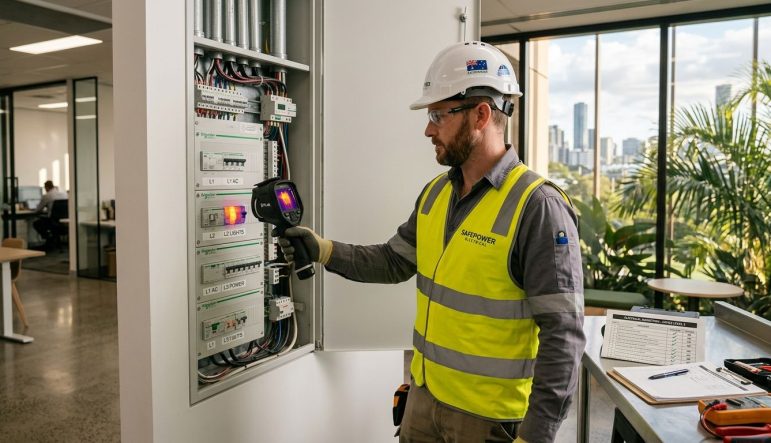
A Brisbane business rarely notices its electrical maintenance program on a good day. The lights work, refrigeration stays cold, air-conditioning starts on schedule, and nobody asks where the latest test records are stored. The pressure arrives when a switchboard trips during trading, an emergency-lighting fault appears during an inspection, or an insurer asks for evidence that safety-critical equipment has been maintained.
Commercial electrical maintenance should therefore be treated as more than a checklist of tests. It should create a clear evidence trail showing what was inspected, who performed the work, what defects were found, how those defects were controlled, and when the equipment was returned to service. Queensland's electrical safety framework gives businesses a strong foundation for this approach, with the Electrical Safety Act 2002 review identifying the Act as the formal framework underpinning maintenance, inspections, and incident reporting across the state.
A Fortitude Valley café can trade for years without a serious electrical complaint, then lose half a trading day when an ageing safety switch trips repeatedly during lunch. The outage is only the immediate problem. The difficulty comes when an insurer asks for test history and the manager can produce only an invoice from an earlier repair.
A scheduled program prevents that evidence gap. It records planned inspections, test results, defects, corrective actions, and return-to-service decisions. It also gives the electrician a usable history. A recurring trip, rising temperature, or worsening test result can then be assessed as a trend rather than treated as a one-off nuisance.
A competent electrician can identify warning signs before they become an operational failure:
Queensland's historical data shows why these controls matter. The state recorded a peak of 39 confirmed serious electrical incidents in 2010/11, falling to 17 in 2013/14. The same review recorded Queensland's average electrical fatality rate over the previous five years at about 3.57 fatalities per million people, compared with a national average of 2.18. Those figures do not prove that every maintenance program prevents an incident. They do show why electrical controls remain a serious Queensland workplace issue. Those figures come from the same OIR QLD review cited earlier.
Practical rule: If a defect is important enough to repair, it is important enough to document.
Reactive work still has a place. A failed contactor, damaged socket, or tripping circuit needs prompt attention, and delaying that response can create a larger operational or safety problem. The mistake is letting emergency repairs become the entire maintenance system.
Brisbane's humid subtropical conditions, air-conditioning loads, moisture, dust, and heavily used equipment can expose weaknesses at inconvenient times. Planned servicing lets the facility manager select an access window, arrange isolation, protect stock, and brief tenants before a fault interrupts trade. It also creates dated records that can support discussions with insurers, auditors, landlords, and internal risk teams.
The comparison is planned work against emergency attendance, lost production, spoiled goods, disrupted tenants, and an evidence gap when someone asks what the business knew and when it acted.
Start with an asset register. It doesn't need to be complicated, but it must identify what receives power, who controls it, and what happens if it fails. For a typical Brisbane commercial property, the first inventory should include the main switchboard, distribution boards, RCDs, emergency and exit lighting, three-phase air-conditioning circuits, general socket outlets, fixed equipment, generators, UPS systems, solar inverters, and outdoor or hazardous-area equipment where present.
Record the asset location, circuit reference, condition, responsible party, and maintenance history. Photographing labels and board interiors can help a contractor identify equipment quickly, provided access and safety controls are respected.
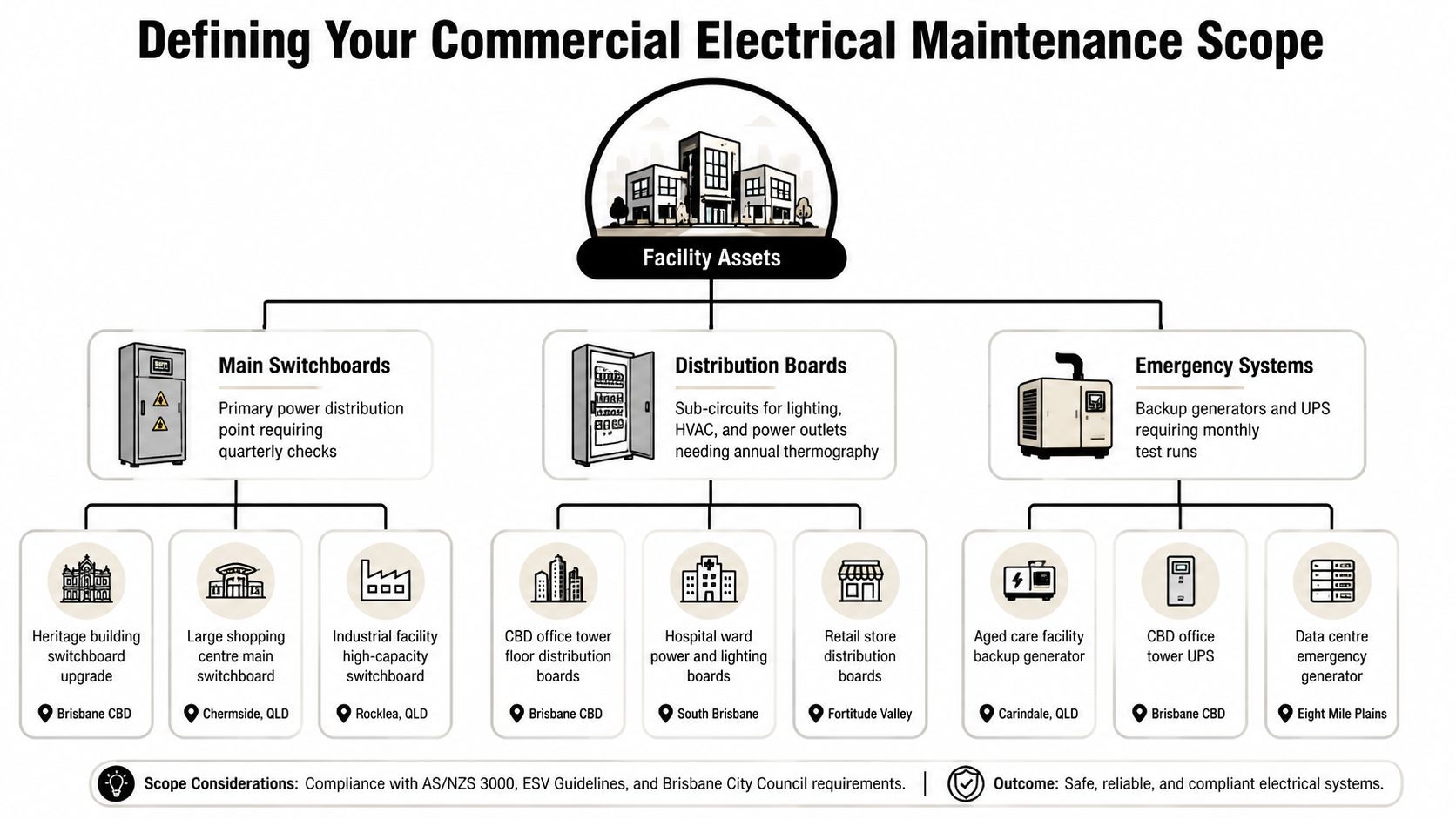
A useful scope groups assets by consequence rather than by the room they're installed in.
That classification helps set priorities when the budget is limited. A loose connection feeding a server room deserves a different response from a damaged light fitting in a low-occupancy storage area, although neither should be ignored.
Nominate a responsible person, usually the building owner, facility manager, or building manager. That person should control the maintenance register, approve isolation plans, review open defects, and know who must be contacted after a failed test.
Define the boundaries as well. A tenancy fit-out may belong to the tenant, while the main switchboard and shared risers may remain the landlord's responsibility. In a body corporate property, some supplies and common-area systems may sit outside an individual tenancy's control. Write down whether an asset is landlord-owned, tenant-owned, body-corporate controlled, or shared.
Also document escalation. A serious defect shouldn't sit in a contractor's email inbox. The scope should state who isolates the circuit, who authorises repair, who informs affected tenants, and who signs off the return to service. A written boundary prevents maintenance drift and gives an incoming contractor a defensible starting point instead of the vague instruction to “have a look around”.
There isn't one sensible interval for every commercial tenancy. A quiet, dry, air-conditioned office places different demands on electrical equipment from a commercial kitchen, workshop, carpark, or outdoor signage installation. The maintenance plan should reflect the environment, equipment use, manufacturer instructions, access arrangements, and consequences of failure.
Queensland workplace rules require electrical equipment to be tested at least every 12 months if it is double-insulated, or every 6 months if it isn't, under the Electrical Safety Regulation 2013. The same regulation provides for specified workplace socket-outlets to have non-portable type 1 or type 2 safety switches. These are minimum compliance points, not a complete risk assessment.
| Asset or System | Standard Environment | Harsh Environment, kitchen, carpark, coastal |
|---|---|---|
| RCDs and safety switches | Schedule professional testing and retain results | Shorten the interval where moisture, heat, dust, or heavy use increases exposure |
| Portable electrical equipment | Use the applicable Queensland testing interval and risk assessment | Use a more frequent cycle where equipment is moved, contaminated, or exposed to damage |
| Switchboards and distribution boards | Planned visual inspection and targeted thermal assessment | Increase inspection attention where heat, salt, dust, or high load is present |
| Emergency and exit lighting | Scheduled function and discharge testing | Check more closely where fittings face heat, moisture, vibration, or public exposure |
| Outdoor equipment and signage | Inspect enclosures, cabling, isolation, and weather protection | Bring forward inspections where water ingress, corrosion, or physical damage is likely |
For businesses needing a practical reference on portable equipment processes, electrical testing and tagging guidance can help frame the conversation with a contractor. The record matters as much as the date. Keep the service report, instrument result, asset identifier, defect status, corrective action, and next due date together.
Queensland maintenance-plan guidance also recommends push-button safety-switch testing by tenants every 3 months and operational testing by a licensed electrician every 2 years as a layered benchmark. The guidance is available through the Queensland electrical maintenance-plan material. Recent Australian guidance also places greater attention on periodic emergency-system maintenance, including six-monthly emergency-lighting discharge testing, but the responsible person should confirm the applicable requirement for the specific installation and occupancy.
A schedule that nobody records isn't a maintenance program. It's an intention.
Give the contractor a checklist that distinguishes a safe visual inspection from work requiring isolation, a licence, and calibrated instruments. A facility manager can inspect for obvious damage, blocked access, missing labels, water ingress, and unusual smells. They shouldn't open energised equipment or attempt electrical tests.
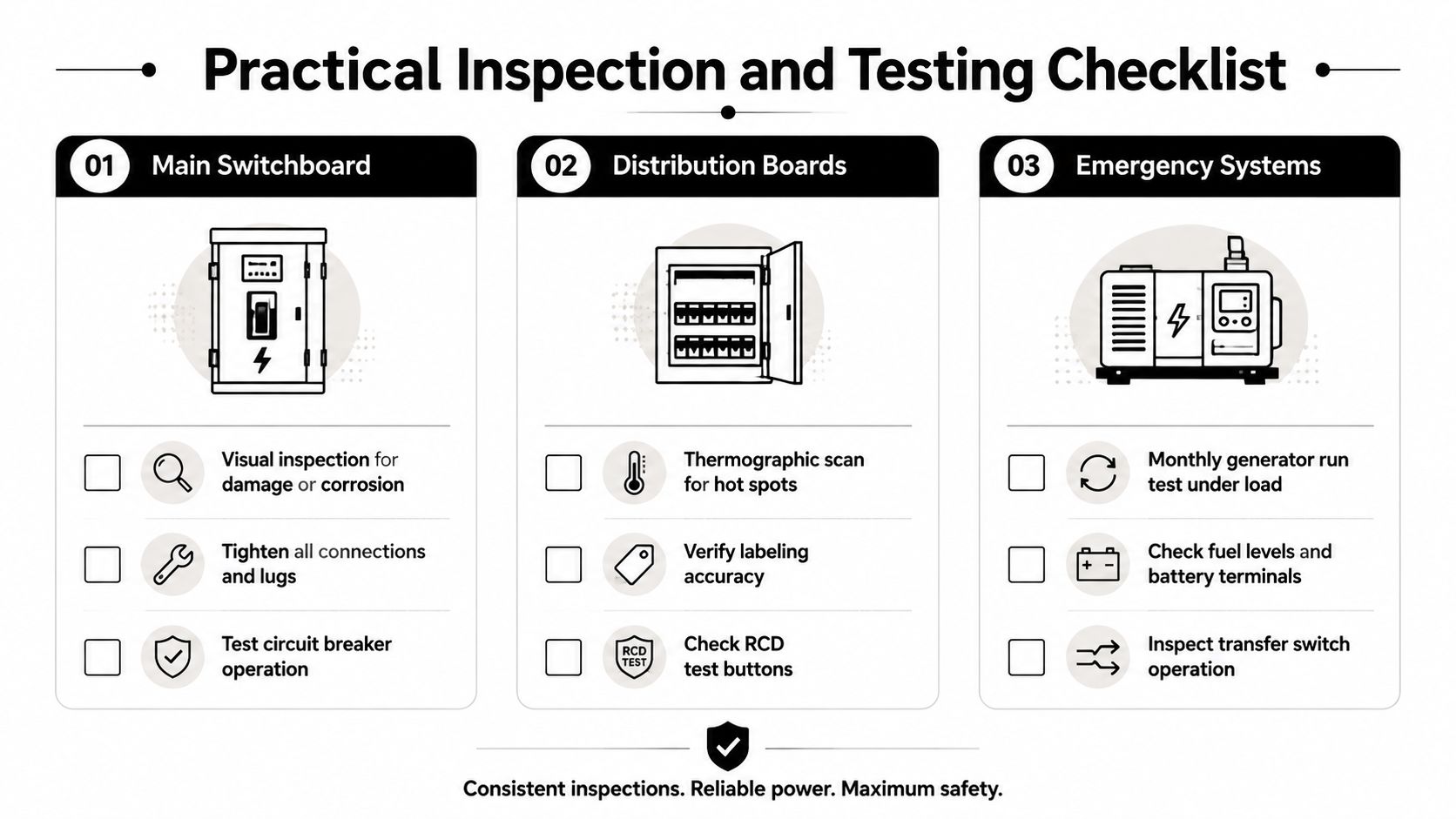
Ask the electrician to record:
The pass or fail decision belongs to the competent licensed worker, who should record the benchmark applied and any limitation on the test.
Emergency and exit lighting needs more than a glance at the illuminated sign. Check lamp and diffuser condition, charging indicators, battery swelling or leakage, cable condition, and the result of the required discharge test. A discharge test verifies that the battery can support the fitting for its designed emergency period, while a visual check alone cannot establish that capacity.
For UPS systems and surge protection devices, record indicator status, alarm history, bypass condition, battery condition, and the manufacturer's service requirements. A UPS may appear normal while carrying a battery fault in its event history, so the log must capture more than the front-panel light.
Inspect socket outlets for looseness, cracking, heat damage, and missing covers. A licensed electrician should verify RCD coverage, assess load balance with a clamp meter where required, and test three-phase equipment for correct operation and protective-device coordination.
Include generators, transfer switches, solar inverters, pumps, refrigeration, and outdoor equipment in the asset-specific section. A generator run test should identify whether it starts, carries the intended load, transfers correctly, and returns safely to normal supply. The test record should state what was tested and what remained outside the test.
A useful visual reminder is the commercial electrical maintenance inspection video, but video content doesn't replace a site-specific risk assessment or test sheet.
Queensland's Electrical Safety Act 2002 provides the statewide compliance foundation, while the Electrical Safety Regulation 2013 sets practical requirements for electrical equipment, testing, maintenance, and workplace controls. The person conducting a business or undertaking, or another person in control of the workplace, must take reasonable steps to ensure electrical equipment is safe and maintained.
Work that meets the definition of electrical work must be completed by an appropriately licensed electrical worker. Maintenance staff can report damage, keep areas clear, operate equipment as instructed, and perform permitted user checks, but they must not cross into licensed electrical work because a contractor isn't available.
Keep the evidence where the responsible person can retrieve it quickly:
The electrical inspection report guide is a useful way to assess whether a contractor's report contains practical evidence rather than only a broad statement that the site was inspected.
Queensland guidance requires unsafe equipment to be isolated immediately, then repaired or tested before it is re-energised. If the maintenance regime isn't documented and records aren't kept at the workplace, administrative gaps can continue even when physical repairs have been completed.
Administrative drift is common. A facility may have several reports, but nobody checks whether defects were closed, whether the next due dates were entered, or whether the same circuit has failed repeatedly.
Assign one responsible person to review the register each quarter. That review should identify overdue tests, open serious defects, repeated failures, changes to tenant equipment, and any asset added since the last cycle. For some licensed venues, a broader Safety Management System may also apply. The Electrical Safety Office can make enquiries during audits or incident investigations, so a tidy evidence trail is a practical operating control, not paperwork for its own sake.
A precise maintenance price can't be set from floor area alone. A small office with one accessible switchboard is a different job from a hospitality venue with refrigeration, cooking equipment, exhaust systems, emergency lighting, after-hours access, and several tenant interfaces.
The budget should compare three operating models:
The main cost drivers are the number of switchboards, three-phase equipment, ceiling height, after-hours access, age and condition of the installation, site environment, and whether usable records already exist. A contractor also needs to price safe isolation, tenant coordination, travel between buildings, reporting, and remedial work separately.
| Site Type | Preventive Program, annual | Reactive Spend, annual | Main Cost Drivers |
|---|---|---|---|
| Small office | Set a recurring allowance based on assets and required tests | Unpredictable, dependent on failures | Accessible boards, low equipment count, tenancy access |
| Retail tenancy | Calendar-based testing with planned defect repairs | Callout exposure during trading hours | Trading disruption, signage, refrigeration, customer access |
| Light industrial | Broader inspection program with condition assessment | Potentially high when production equipment fails | Three-phase machinery, dust, isolation planning, switchboard access |
| Hospitality venue | Frequent risk-based checks and planned after-hours work | Disruption, stock risk, and urgent attendance | Kitchens, moisture, heat, refrigeration, emergency systems |
These ranges are deliberately qualitative because every site needs a scope before a responsible price exists. The cheapest quote can become the most expensive option when it excludes reporting, thermal assessment, defect documentation, or return visits.
A sound budget separates routine testing from remedial repair. That makes it easier to approve urgent work without losing visibility over the planned program. It also prevents a contractor from burying significant defects inside a low fixed visit price.
For a Brisbane facility, contractor selection should start with licence verification and finish with evidence management. Confirm the provider holds a current Queensland Electrical Contractor Licence and that the electricians assigned to the work hold the licences required for the tasks. Check whether the business has the relevant commercial experience, understands isolation procedures, and can work around tenants, trading hours, production areas, and sensitive equipment.
Don't rely on a logo or a polished proposal. Ask for documentation.
A practical pre-engagement file should include:
For a broader procurement process, this contractor verification step by step resource can help facility managers organise checks before approving a provider.
| Verify Before Hiring | Warning Signs to Avoid |
|---|---|
| Written scope listing assets, exclusions, tests, and deliverables | Verbal-only pricing with no defined asset list |
| Licence and insurance documents | Reluctance to provide current credentials |
| Calibrated test equipment and identifiable results | No instrument details or unexplained pass statements |
| Defect register with risk and close-out status | Defects mentioned casually but never recorded |
| Updated circuit schedules and labels where needed | Refusal to correct inaccurate board information |
| Asset-based pricing with remedial work separated | A low visit price that hides excluded testing |
| Clear emergency response and isolation process | Promises of immediate attendance without practical details |
Ask these questions on the first call:
A contractor should be comfortable answering those questions. If the response is “we'll see what we find”, the scope isn't ready.
DLG Electrical provides commercial electrical maintenance, inspections, testing, and repairs for Brisbane businesses, with the work structured around operational continuity and compliance documentation. Its commercial electrical contractor service is one option for managers comparing local providers, but the same verification standards should apply to any contractor.
Week one: Assemble the asset inventory, existing reports, switchboard schedules, certificates, defect notices, and tenant responsibility agreements. Mark missing documents instead of assuming the installation has no history.
Week two: Book a switchboard condition assessment, targeted thermal scan, RCD testing, emergency-lighting review, and document audit. Ask the contractor to separate immediate safety defects from planned upgrades.
Week twelve: Review the defect register, confirm which repairs were closed, update the logbook, check that records are stored at the workplace, and approve the scope and cadence for the next maintenance cycle.
How often must RCDs be tested in a commercial tenancy? The correct interval depends on the installation, environment, applicable standard, and workplace requirements. Queensland guidance provides layered benchmarks, including tenant push-button checks every 3 months and licensed operational testing every 2 years, while the applicable test schedule may be more frequent for hostile or high-use environments. Keep the electrician's written recommendation with the site risk assessment.
What records should remain on site? Keep the asset register, test sheets, RCD log, defect reports, repair evidence, certificates of compliance where applicable, technician details, instrument information, and next-due dates. Recent Australian compliance guidance increasingly focuses on proving that work occurred, not merely stating that it occurred.
Who carries responsibility if an incident occurs and records are missing? The property owner or person in control may have duties that cannot be transferred just by hiring a contractor. A contractor is responsible for the work it performs, but the person in control still needs to select competent providers, provide safe access, act on defects, and maintain appropriate oversight.
Can maintenance reduce insurance premiums? It may support an insurer's risk assessment, but no premium reduction should be assumed. The practical benefit is stronger evidence during underwriting, renewal, or a claim, especially when reports show defects were identified and addressed.
What should happen when a serious defect is found? Isolate the unsafe equipment immediately, record the condition, arrange licensed repair or testing, and don't reconnect it for intended use until the defect has been addressed and the return-to-service decision is documented.
DLG Electrical can help Brisbane businesses organise commercial electrical maintenance around inspections, testing, repairs, switchboards, emergency systems, and a usable evidence trail. Visit DLG Electrical to discuss your site, request a quote, and start building a maintenance program that supports safer operations and faster answers for insurers, auditors, tenants, and staff.

Master Electrician with over 30 years of experience. Founded DLG Electrical in 2005 after international project work including electrical installations at Stamford Bridge Stadium, London(Home of Chelsea FC).

Local Electricians that can fix all Electric Hot water Systems.
Motion sensor lights are a versatile addition to any home, offering nu
