83 Jean St, Grange QLD 4051
Mon-Fri 07:30 AM - 04:00 PM - Sat - 8:00 - 12 - Sunday Closed
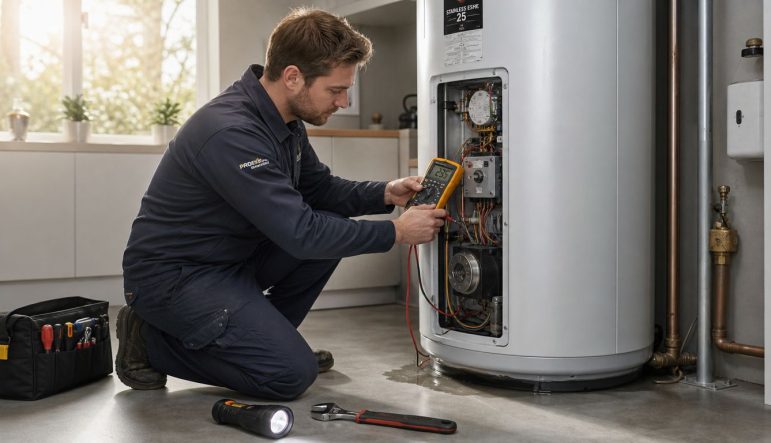
You turn on the shower, wait for the usual burst of heat, and nothing happens. The water stays cold, or it goes lukewarm and never gets better. In Brisbane homes with electric storage systems, that usually means something simple has interrupted the heating cycle, or a key component has failed and needs proper testing.
If your electric hot water service is not working, the right first move isn't guesswork. It's a calm check of the safe items you can inspect without opening covers, touching wiring, or trying to outsmart the switchboard. That matters for comfort, but it matters for your power bill too. In Australia, water heating uses approximately 15% to 30% of total household energy use, which is why a failed system often shows up as both a household headache and an energy problem during colder periods, according to this Australian hot water energy use reference.
Most Brisbane homeowners call at the same point. The shower has gone cold, the dishwasher isn't cleaning properly, or the tank seemed fine yesterday and dead today. Electric systems often fail in a way that feels sudden, but there is usually a logical cause behind it.
The important part is separating safe homeowner checks from anything that crosses into electrical fault-finding. You can look at the switchboard. You can think about whether the unit is on an off-peak tariff. You can notice leaks, smells, and unusual sounds. What you shouldn't do is remove covers, test live parts, or keep resetting a breaker that won't hold.
A total loss of hot water in an electric storage system usually comes down to one of a few paths:
In Brisbane, local conditions make this a bit more specific. Humidity, storms, and off-peak setups create fault patterns that generic interstate advice often misses. A system can look dead when it's really waiting for its tariff-controlled heating period. On the other hand, a switch that trips instantly is not a nuisance. It's a warning.
Practical rule: If the unit has simply stopped heating, start at the switchboard. If there is water around the tank, a burning smell, or repeated tripping, stop troubleshooting and organise a licensed electrician.
What works is a short, methodical check. Confirm power. Confirm timing. Confirm symptoms.
What doesn't work is replacing parts based on guesswork, assuming every cold tank has a dead element, or asking the same breaker to keep proving the point. One careful reset can tell you something useful. Repeated resets usually tell you the fault is still there.
Your switchboard is the first place to look because it tells you whether the hot water service has lost power. In many Brisbane homes, the circuit will be labelled Hot Water, HWS, or something similar. If you're not sure, don't start switching random breakers on and off. Read each label slowly and find the one that clearly belongs to the hot water system.
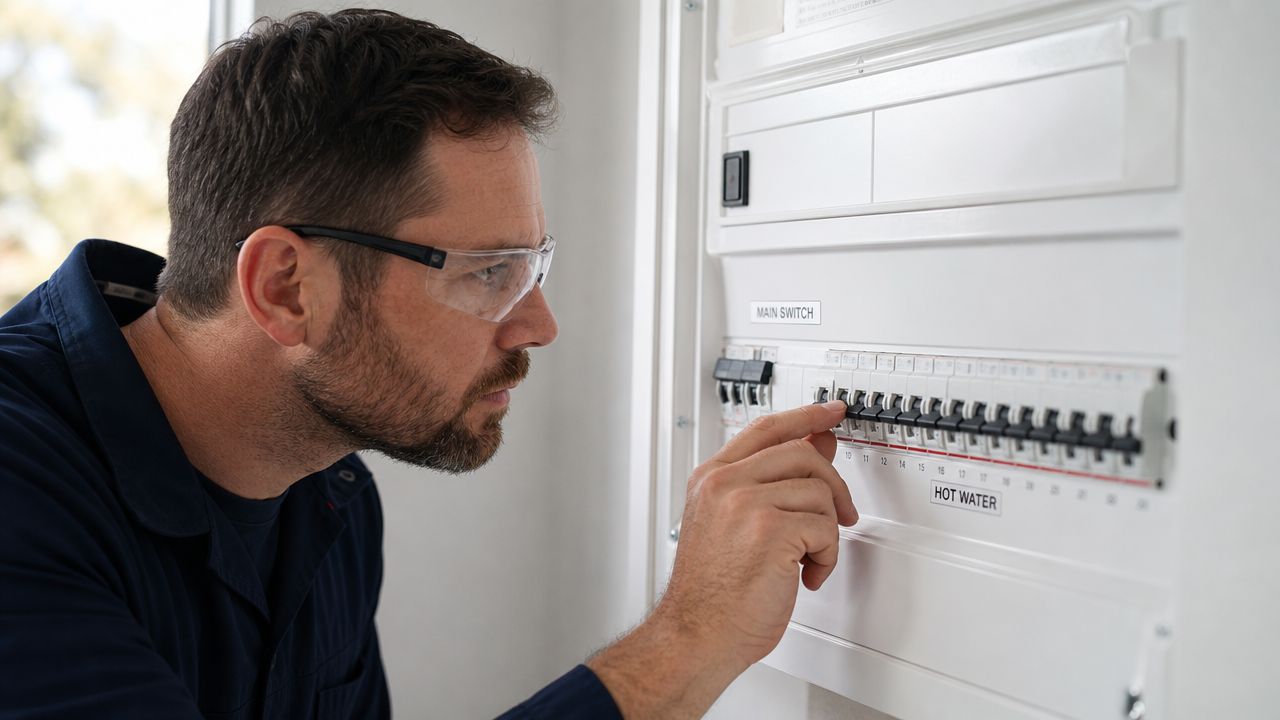
Stand on a dry surface. Make sure your hands are dry. Open the switchboard and look for any breaker or safety switch sitting in the middle position or fully off.
If you find the hot water breaker tripped, you can reset it once. Push it fully to off first if needed, then back on. After that, leave it alone and watch what happens.
Use this simple decision path:
Breaker resets and stays on
The unit may have lost power and now needs time to heat, especially on a storage system.
Breaker trips again immediately
Stop there. Don't keep trying.
Nothing is tripped but there is still no hot water
The fault may be inside the system, or the unit may be controlled by tariff timing rather than continuous supply.
A lot of online advice treats a tripped breaker as a quick reset job. That's too casual for hot water systems. According to this Australian hot water electrical fault warning, electric hot water systems are a leading cause of residential electrical faults because corroded heating elements can cause earth leakage. The same guidance notes that a breaker that trips immediately after resetting is not a glitch but a confirmed fault, and DIY resetting creates a fire or electrocution risk.
That's the line in the sand.
If the hot water breaker or safety switch won't stay on, isolate the issue by leaving it off and call a licensed electrician.
If you're unsure what type of protective device you're looking at, this guide on how a safety switch works in a home switchboard helps explain the difference between circuit protection and personal shock protection.
A single reset is a test. Repeated resets are risk-taking.
Once the switchboard check is done, the next step is working out whether the issue is electrical supply, a failed component, or tariff timing. In Brisbane electric storage systems, those three causes dominate. According to this Brisbane electric hot water troubleshooting reference, a tripped circuit breaker, a failed heating element, and a faulty thermostat account for approximately 85% of all "no hot water" calls.
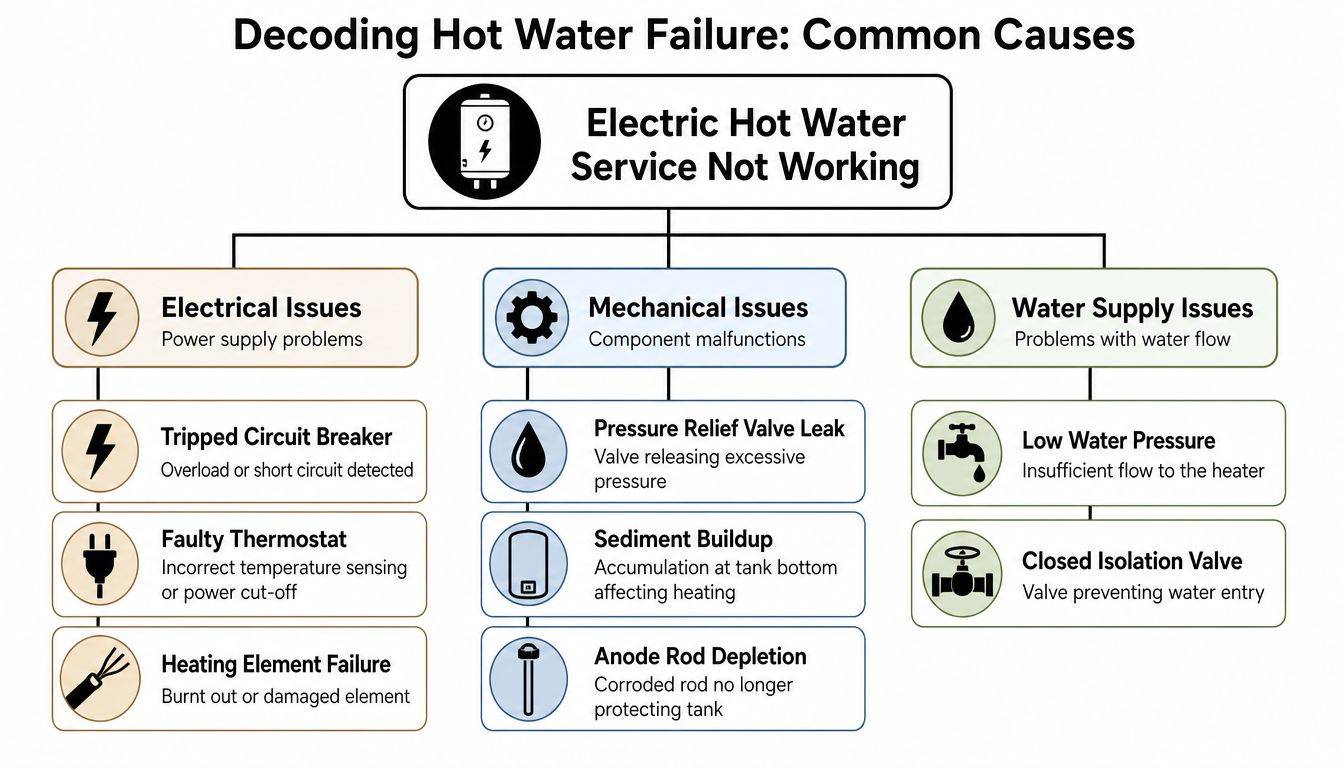
Tripped breaker or safety switch
This is the obvious one, but it has two very different meanings. Sometimes it was a one-off interruption. Sometimes it points to an internal fault, especially if it won't hold when reset.
Failed heating element
The element is responsible for heating the tank. When it burns out or deteriorates, the system may produce no hot water at all, or it may deliver only water that feels barely warmed.
Faulty thermostat
The thermostat controls when the element heats and when it cuts out. If it isn't sensing correctly or switching properly, the tank may stay cold or never reach a useful temperature.
For a broader comparison with another city's plumbing-focused perspective, Voyager Plumbing has a practical Sydney homeowner's guide to no hot water that helps show how the same symptoms can overlap while local system setups still change the likely diagnosis.
This is the part many generic guides miss. A lot of Brisbane electric storage systems are wired to off-peak tariffs, which means they don't heat all day. They heat during designated lower-cost periods. If the system hasn't had its heating window yet, homeowners often assume the service is broken when it is merely waiting for supply.
The same Brisbane troubleshooting reference notes that assuming the element is dead without checking off-peak tariff timing can delay up to 30% of repair appointments. That's a major clue when the complaint is, "It worked last night, but there's nothing this afternoon."
A storage unit on off-peak can be healthy and still appear dead during the day if the tank has been emptied and the reheating window hasn't arrived.
This is also where model-specific guidance matters. If you want a second layer of troubleshooting before booking someone, this hot water system troubleshooting guide for homeowners is useful for checking common symptoms without getting into unsafe electrical work.
A quick visual walk-through can help if you're trying to match a symptom to a likely cause:
Cold water all day, breaker stable
Think off-peak timing first, then thermostat or element.
Breaker trips when hot water tries to run
Treat it as a fault, not an inconvenience.
Lukewarm water, not fully cold
Often points to a control or element issue rather than a complete loss of supply.
Hot water returns briefly, then disappears again
That can happen when the tank heats partially, then stops cycling properly.
The goal isn't to diagnose the failed part yourself. It's to narrow the problem safely so the right repair happens faster.
You get home after a stormy Brisbane afternoon, try the shower, and the water is stone cold. You have already checked the switchboard once. At that point, the job changes. The priority is no longer getting hot water back quickly. The priority is making sure the system is safe.
In Brisbane, I take recent weather and local tariff setup seriously because both confuse the diagnosis. Summer humidity speeds up corrosion inside older units, and storm activity can damage circuits, isolators, or controls without leaving obvious marks on the outside. Queensland off-peak arrangements add another layer. Homeowners often assume the system has failed when the tank has merely not had a reheating period yet. Once you've ruled that out, any sign of electrical distress means stop.
Call a licensed electrician immediately if you notice any of these:
Those signs point to fault current, overheating, failed insulation, or water getting where it should not be. None of that is suitable for homeowner troubleshooting.
If there is a burnt smell, visible heat damage, or water near live components, isolate the circuit if you can do it safely at the switchboard and leave the unit alone.
| Symptom | DIY Safe Check | When to Call a Professional Immediately |
|---|---|---|
| No hot water at all | Confirm the hot water circuit is on and your tariff timing makes sense | If supply is present and the system still stays cold |
| Lukewarm water | Note whether the problem happens after heavy use or across multiple days | If recovery stays poor after normal heating periods |
| Switchboard trip | Reset once only if the area is dry and safe | If it trips again |
| Water around the tank | Look only. Do not remove covers or touch wiring | Immediately, especially if water is near controls or cable entry points |
| Strange noise | Listen from a safe distance | Immediately if the noise is electrical, sharp, or paired with loss of hot water |
| Burning smell | Do not inspect internally | Immediately, and keep the circuit isolated |
Electric storage hot water systems look simple from the outside, but fault-finding is not guesswork. Testing an element, checking a thermostat, confirming supply, inspecting an isolator, and determining whether the fault is electrical or plumbing all require the right licence and test equipment. A wrong call can leave the unit unsafe, or send you chasing the wrong repair while the actual fault gets worse.
There is also a repair-versus-replace decision to make. A single failed thermostat in an otherwise sound unit is one thing. A leaking tank, repeated trips, corrosion around terminals, or storm-related damage is different. In those cases, spending money on parts can be poor value.
For a broader trade perspective on why fixed electrical work needs proper standards, Growth 4 Trades electrical insights makes the same point from outside Queensland. Different city, same rule. Electrical faults are not a DIY finish-up job.
If the system is older or showing multiple warning signs, a licensed Brisbane electrician can test the circuit, confirm whether the tariff is part of the problem, and tell you plainly whether the unit is worth repairing. DLG Electrical handles electric hot water fault diagnosis and replacement work. If you want to reduce the chances of getting back to this point, this guide to hot water system maintenance checks for homeowners covers the routine checks that help catch trouble earlier.
Most electric hot water failures don't feel gradual, but many of them build up slowly. Brisbane humidity and storm exposure are hard on components, so basic routine checks make a real difference. You don't need to become a technician. You just need to catch the warning signs earlier.
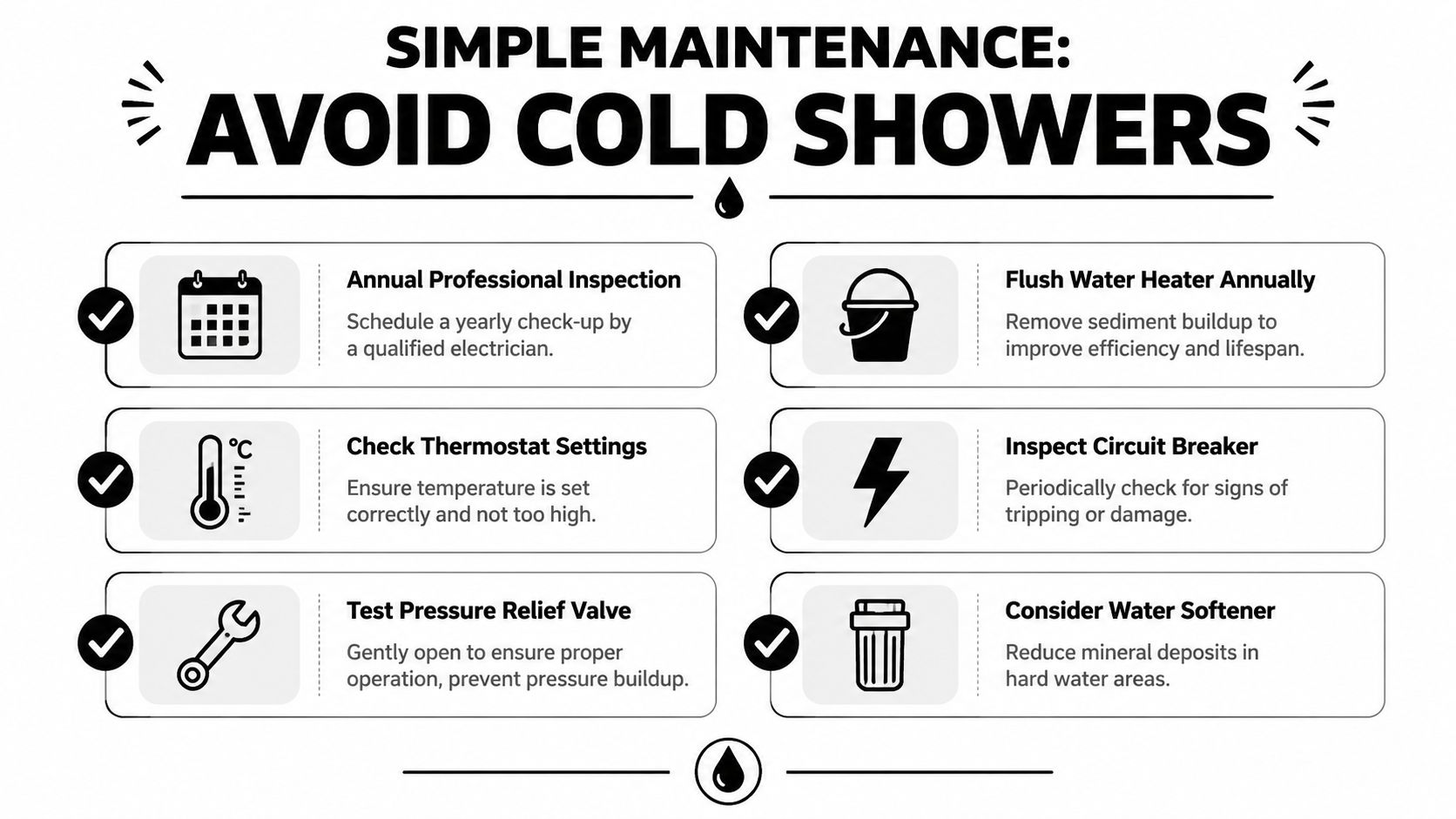
Operating the pressure relief valve at regular intervals can help confirm it isn't stuck, provided you follow the unit instructions and do it safely. Keep an eye on any visible discharge and any staining that suggests the valve or pipework isn't behaving normally.
It also helps to schedule professional servicing instead of waiting for a failure. In Brisbane, annual checks are worthwhile because corrosion and wear often show up before the homeowner notices performance loss.
Maintenance isn't about squeezing perfection out of an ageing tank. It's about spotting the preventable failures before they turn into a cold shower or a switchboard trip.
For a practical checklist you can revisit through the year, this hot water maintenance guide for Brisbane homeowners is a useful reference.
The exact cost depends on the unit model, access, whether the fault is isolated to one part, and whether additional electrical repairs are needed. It can also change if the system has corrosion, wiring damage, or compliance issues that only show up during testing. The best approach is to get the unit assessed properly rather than pricing the part alone.
That depends on the fault. A straightforward repair may be completed in a single visit if the issue is confirmed quickly and the correct part is available. More involved faults take longer, especially when the electrician needs to verify circuit integrity, isolate repeat tripping, or determine whether repair is still sensible.
Service life varies with maintenance, water quality, installation quality, usage, and Brisbane weather exposure. Some tanks give long service. Others deteriorate earlier because corrosion, sediment, or electrical faults catch up with them. If the system has recurring trips, visible rust, leaks, or multiple failed parts, replacement may be more practical than repeated repair.
Yes. In Brisbane, off-peak electric storage systems regularly create this confusion. If the system is wired to heat during specific low-cost periods, it may appear not to be working when it's really outside its normal heating window. That's always worth checking before assuming the tank has failed.
If your hot water has gone cold and you want a safe diagnosis without guesswork, contact DLG Electrical. They can inspect the switchboard side, confirm whether the problem is tariff timing, thermostat failure, element failure, or a more serious electrical fault, and advise whether repair or replacement makes the most sense for your Brisbane home.

Master Electrician with over 30 years of experience. Founded DLG Electrical in 2005 after international project work including electrical installations at Stamford Bridge Stadium, London(Home of Chelsea FC).

Local Electricians that can fix all Electric Hot water Systems.
Motion sensor lights are a versatile addition to any home, offering nu
